
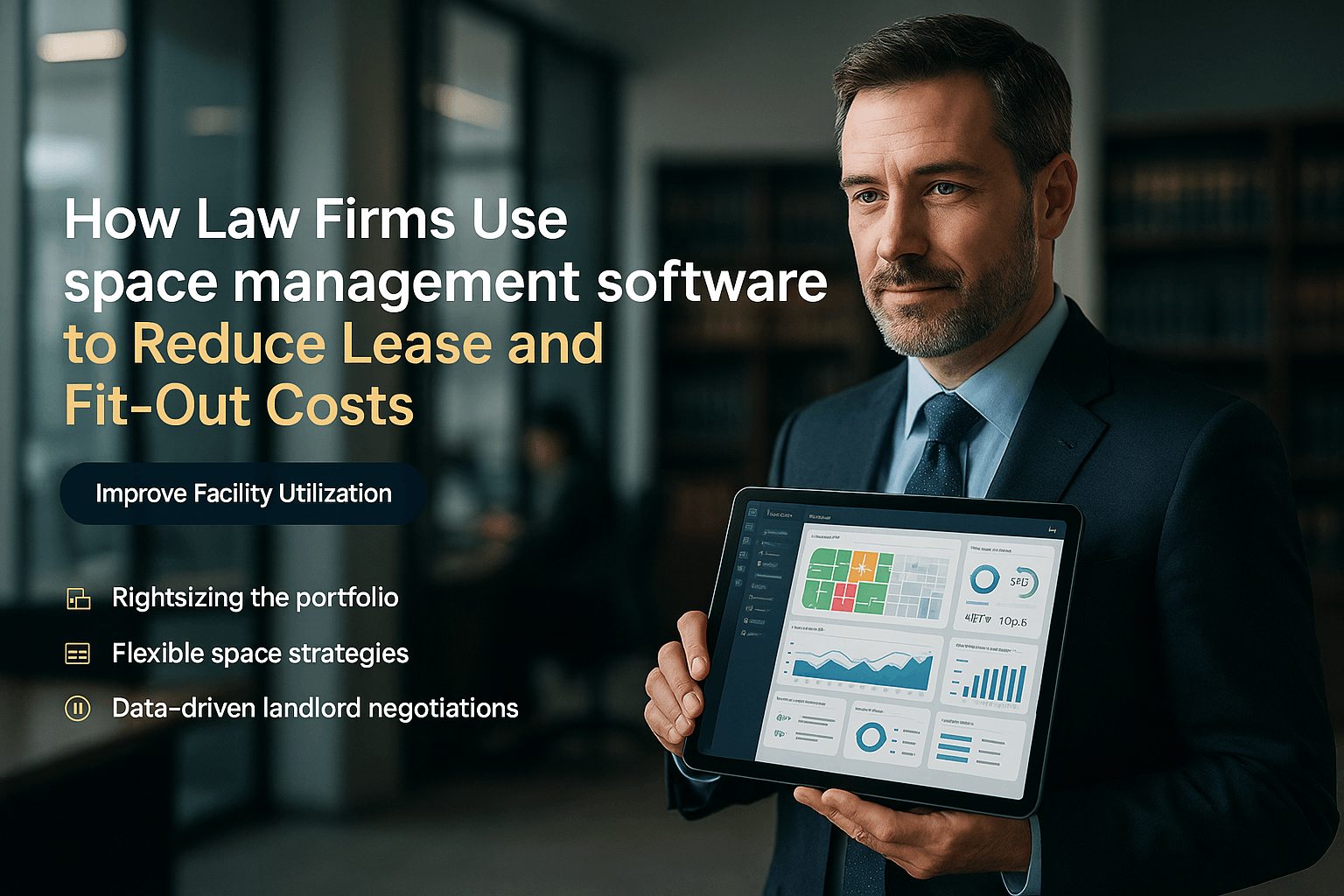
How can space management software help law firms cut lease and fit-out costs?
Space management software centralizes occupancy, lease, and fit‑out data to identify consolidation and rightsizing opportunities, model phased TI spend, and quantify negotiation positions with landlords. It enables extend/relocate/sublease scenario comparisons and delivers near‑real‑time dashboards procurement can use to drive measurable rent reductions and deferred capital expenditure.
How office space management software reduces real estate and fit-out expenses
Rightsizing the portfolio
Run combined audits using sensors, booking logs, and headcount data to compare current footprint with target staffing and actual utilization.
- Example: a 200‑attorney firm combined sensor and booking data, found 25% average desk vacancy, consolidated two partial floors, and achieved a 15% rent saving.
- Business impact: lower rent, reduced services costs, and better space-per-FTE alignment.
Flexible space strategies and phased fit-outs
Adopt modular fit-outs, hoteling, and shared client amenities to reduce fixed desk counts. Phase TI works so client-facing suites are prioritized and back-office areas are deferred to match realized occupancy.
- Benefits: deferred capex, staged contractor commitments, and lower rework risk.
- Approach: standardize templates, then apply phased deliverables tied to utilization triggers.
Data‑driven landlord negotiations
Use utilization-backed scenarios and lifecycle cost models to secure TI concessions, rent abatements, or flexible break options. Concrete vacancy trends and modeled cashflows strengthen procurement’s negotiation leverage.
Implementing space management software: process and best practices
Stakeholder alignment and requirements gathering
Engage partners, practice managers, IT, and facilities early. Run workshops to map client meeting needs, confidentiality zones, and IT wiring constraints to reduce rework and set clear standards.
Audit, mapping, and policy creation
Create a single source of truth: normalized floorplans, headcount, assigned space, and reservation policies. Use the software to enforce desk allocation, meeting-room booking, and support SLAs to cut ad hoc requests that inflate fit-out scope.
Change management for attorneys and staff
Pilot new layouts with small teams, gather structured feedback, and provide booking training plus a defined feedback loop. Early pilots uncover hidden needs (for example, secure interview rooms) and lower adoption resistance.
Lease management tools and strategies for lower occupancy costs
Lease lifecycle management
Track critical dates, escalation clauses, and break options centrally. Automate reminders for renewal windows so procurement can act proactively and avoid last-minute relocations or premium payments.
Scenario planning and cost modeling
Compare extend vs. relocate vs. sublease using modeled TI costs, rent-free periods, and NPV cashflow impacts. Phased relocation models often reduce net present cost versus immediate full fit-outs.
Vendor and contractor control for fit-outs
Standardize fit-out scopes, use competitive tendering, and stage approvals tied to budget thresholds. Enforce compliance and schedule performance with contract milestones to limit scope creep.
Office utilization tracking metrics and analytics law firms must monitor
Core utilization KPIs
- Peak vs. average desk occupancy
- Meeting-room utilization
- Space per FTE
Capture data from sensors, booking logs, and badging systems to validate behavioral change and quantify consolidation or sublease opportunities.
Dashboarding and reporting for procurement
Produce executive dashboards with cost-per-seat, vacancy rates, and TI exposure. Schedule regular reports to support lease decisions, budget cycles, and stakeholder sign‑off.
Ensuring data quality and compliance
Integrate space management software with HR, lease accounting, CAFM/IWMS, and access control systems. Maintain accurate headcount alignment and secure audit trails to protect confidentiality and meet regulatory needs.
ROI and workspace cost optimization: measuring savings and justifying investment
Quantify rent reductions, deferred TI, and operational cost avoidance to build a procurement-backed business case. Benchmark cost-per-seat and area-per-lawyer to prioritize high-ROI interventions and forecast payback.
- Useful metrics: % reduction in leased sqft, TI cost per sqm, and time-to-fit-out.
- Timeline: pilots yield wins in 3–6 months; lease and TI savings realized over 6–18 months.
Conclusion
Space management software gives law firms the visibility and controls procurement needs to turn occupancy insights into lower lease and fit‑out costs. By combining utilization tracking, disciplined fit‑out governance, and proactive lease lifecycle management, firms can preserve client-facing quality while optimizing occupancy spend.
Key Takeaways
- Space management software converts utilization data into negotiation leverage and cost savings.
- Integration of lease management and utilization tracking enables phased, lower-cost fit-outs.
- A focused 3–12 month program (audit → pilot → roll‑out) typically produces measurable ROI.
Discover how eFACiLiTY can optimize your facility management. Schedule a demo today.
FAQ
What is office space management software and why does it matter for law firms?
Office space management software centralizes floorplans, bookings, utilization, and lease data to inform rightsizing, fit-out decisions, and landlord negotiations. For law firms it creates defensible procurement evidence, reduces unnecessary TI spend, enforces client-facing standards, and supports compliance through secure audit trails.
How quickly can a law firm expect to see savings?
Early operational wins—reduced meeting-room waste and better desk allocations—typically appear in 3–6 months. Larger lease and TI savings usually materialize over 6–18 months as consolidation, renegotiation, or phased fit-outs are executed based on verified utilization data and stakeholder sign‑off.
Can this software integrate with our existing lease and HR systems?
Yes. Modern space management solutions offer APIs and connectors for lease accounting, CAFM/IWMS, HR systems, and access control. Integration aligns headcount, automates reporting, and maintains audit trails needed by procurement and finance while preserving data security and operational efficiency.




