
How does CAFM Software reduce production downtime?
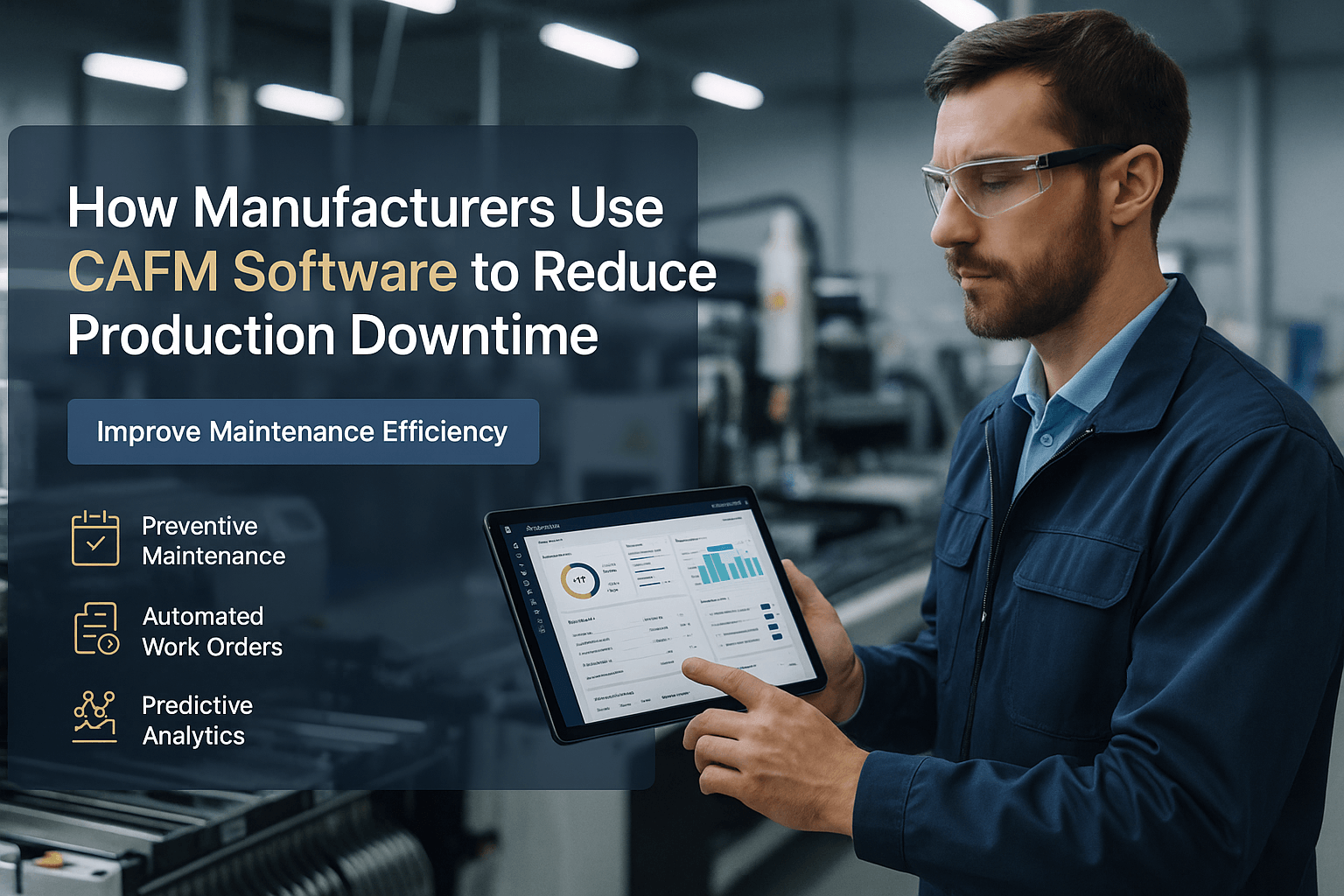
CAFM Software reduces downtime by triggering condition-based work orders from IIoT feeds, prioritizing repairs using MES production context, and automating spare-part reservations. This enables preventive and predictive maintenance, faster diagnostics, and higher first-time-fix rates—delivering measurable drops in unplanned stoppages and shorter MTTR within months.
Core modules that matter for electronics manufacturing
Asset registry and configuration management
A verified asset registry links part numbers, BOMs, serial numbers, repair history, and calibration records so technicians spend less time searching and more time repairing. This reduces incorrect replacements and speeds diagnosis.
Work order and technician management
Automated work-order routing by priority, SLA, and skill set shortens response lag. Mobile technician apps deliver step-by-step procedures, images, and approvals to cut MTTR and increase first-time-fix rates.
- Preventive & predictive maintenance: calendar and condition-based PMs tied to vibration, temperature, and cycle counts.
- Real-time equipment tracking: machine state and production KPIs displayed together for fast triage.
- Analytics: MTTR/MTBF dashboards and RCA tools to eliminate chronic failures.
Implementing CAFM Software for maintenance management
Deployment phases and responsibilities
Successful rollouts follow phased workstreams: asset discovery and data cleanup (maintenance + engineering), PM configuration (maintenance planners), PLC/IIoT and MES integration (IT + automation), and pilot-to-scale (operations + HR). Start with a high-impact pilot to prove value.
Best practices for faster value
- Clean and verify asset data before integration.
- Use prebuilt PM libraries and mobile guides to accelerate adoption.
- Align KPIs across maintenance, production, quality, and procurement.
Integrating CAFM with production equipment tracking and factory systems
Common data flows
Sensor/IIoT → CAFM events (vibration, thermocouple, current) create condition-based work orders. MES → CAFM supplies scheduled downtime and lot priority for repair timing. ERP/inventory → CAFM automates part reservations and procurement triggers to ensure spare availability.
Electronics-specific use cases
- SMT feeders: usage-based scheduling tied to yield data reduces feeder-related stops.
- Reflow and wave-solder ovens: thermocouple drift detection triggers calibration orders to avoid rework.
- PCB assembly lines: vibration and temperature trending prevents alignment drift and lowers scrap.
Measuring ROI and continuous improvement with CAFM Software
Metrics to track
- Unplanned downtime reduction (hours/month)
- MTTR and MTBF trends
- Maintenance cost per unit and planned vs. unplanned work percentages
Governance and continuous gains
Quarterly RCA review cycles and cross-functional KPI governance refine PM intervals and predictive thresholds. Shifting reactive work to planned tasks often reduces both downtime and maintenance cost, driving throughput and margin improvements.
Conclusion
When integrated with IIoT, MES, and ERP, CAFM Software becomes a central reliability lever for electronics manufacturers—reducing unplanned stops, improving spare-part readiness, and speeding repairs to protect yield and on-time delivery.
Key Takeaways
- CAFM Software enables predictive maintenance, automated work orders, and faster technician response.
- Phased implementation, clean asset data, and MES/IIoT/ERP integrations accelerate value.
- Track downtime hours, MTTR/MTBF, and planned vs. unplanned work to measure ROI.
Discover how eFACiLiTY can optimize your facility management. Schedule a demo today.
FAQ
How quickly can CAFM Software start reducing downtime?
Typical improvements appear within 3–6 months after a focused pilot. Rapid-response workflows and initial preventive PMs reduce immediate failures, while predictive analytics and better spare-part readiness produce deeper reductions in unplanned stoppages over subsequent quarters.
Can CAFM integrate with existing MES and IIoT systems used on the shop floor?
Yes. Modern CAFM platforms support REST APIs, OPC‑UA, MQTT, and middleware connectors to ingest MES context and IIoT telemetry. These integrations enable condition-based maintenance and production-aware prioritization to minimize repair impact on throughput.
What are the common barriers to CAFM adoption in electronics manufacturing?
Common barriers include poor asset data quality, unclear cross-team ownership, missing spare-part linkages, and inadequate training. Address these with early data cleanup, stakeholder alignment, and targeted training to reduce rollout friction and accelerate value realization.




