
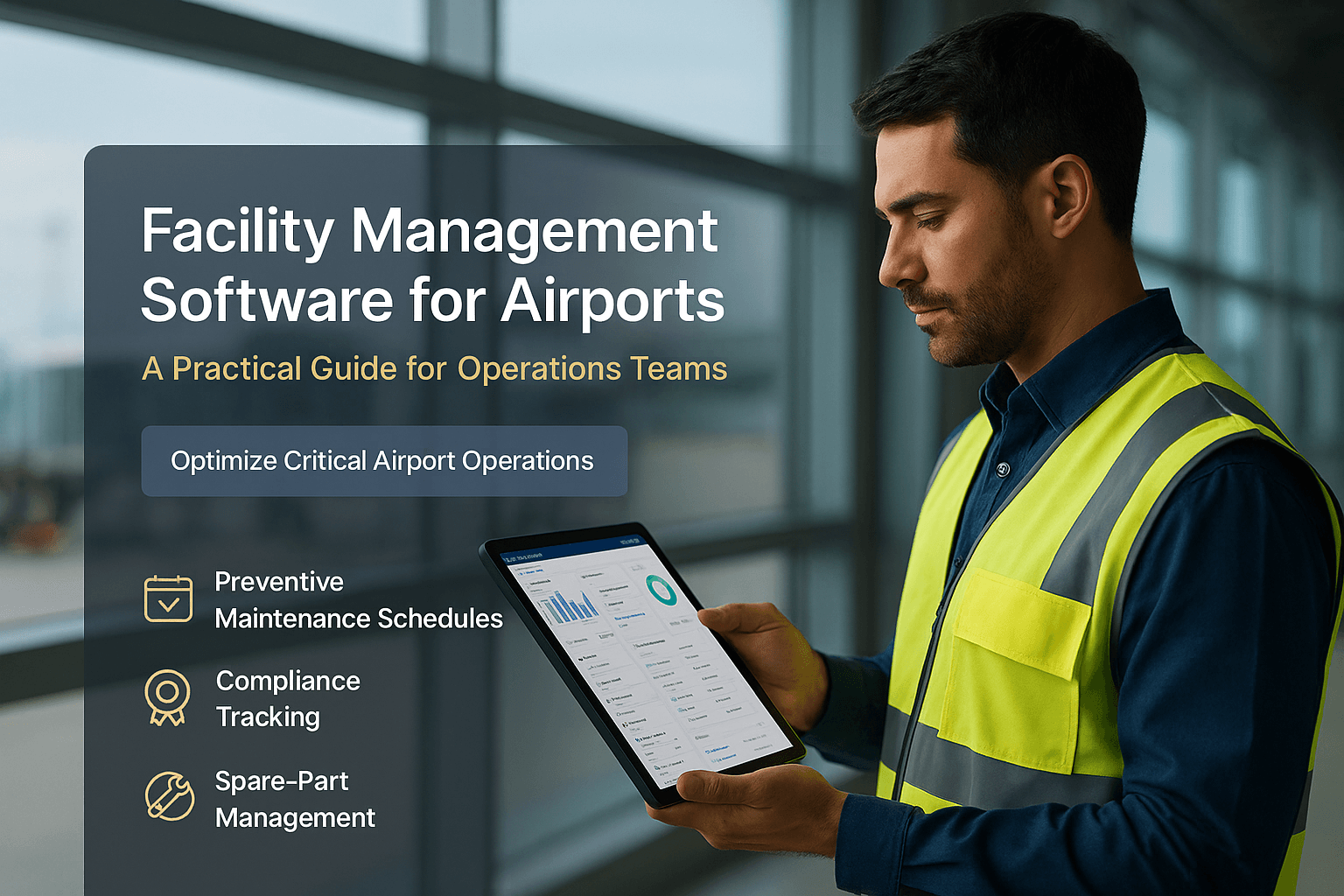
How does Facility Management Software for Airports reduce downtime and improve operational resilience?
By unifying asset data, automating preventive maintenance, and integrating IoT alerts with work-order dispatch, the software prioritizes critical failures and schedules repairs during low-impact windows. This reduces mean time to repair (MTTR), prevents cascading outages, and enables coordinated responses that minimize passenger delays and operational disruption.
What is Facility Management Software for Airports and how does it help airport operations?
Definition and core functions
Facility Management Software for Airports is a centralized CMMS/EAM/CAFM/IWMS platform that replaces fragmented logs and spreadsheets. It manages asset hierarchies, preventive maintenance, certification records, spare parts, and contractor workflows while providing a single source of truth for technicians, planners, and operations control.
Practical example
Tag an airfield AGL bank as critical so work orders, spare allocation, and escalations receive higher priority during outages. Integrations with the AODB and BMS allow maintenance to auto-schedule during low-traffic windows, avoiding gate conflicts and passenger disruption.
- Centralized asset register with criticality and certification tracking
- Preventive maintenance schedules and mobile work-order execution
- Spare-part inventory and contractor management tied to ERP
- IoT-driven predictive alerts and dashboarded asset health
Operational benefits and KPIs
What to measure
Track targeted KPIs to demonstrate value and continuous improvement.
- Asset availability: percent uptime for gates, conveyors, AGL
- MTTR and backlog: mean time to repair and open vs. closed work orders
- Cost metrics: cost per work order and contractor spend
- Compliance: preventive maintenance completion and certification renewal rates
Implementing airport maintenance management: a step-by-step framework
Assessment & inventory
Build a validated asset register covering terminals, gates, MEP, airside pavements, baggage systems, fueling and GSE. Tag by criticality, inspection cycle, and regulatory requirements; attach certificates and calibration records.
Deployment roadmap
Pilot on a single concourse, then roll out enterprise-wide. Integrate with BMS, AODB, and ERP for parts and finance. Phase in predictive analytics as sensor coverage and data quality improve to minimize integration risk.
Change management
Deliver role-based training for technicians, planners, and controllers. Update SOPs and escalation protocols and run shadowing during the pilot to refine workflows and secure stakeholder buy-in.
Choosing terminal operations software: features, integrations, and vendor selection
Must-have features
- Work-order management, preventive schedules, and mobile technician apps
- Asset lifecycle management and certification tracking (EAM/CAFM)
- Integrations with AODB, BMS, baggage systems, and contractor portals
- Multi-site support, performance SLAs, cybersecurity, and flexible deployment (cloud/on-premise)
Vendor checklist
Confirm airport asset data model support, request clear TCO with integration and change-management costs, and require performance and security SLAs tied to milestones.
Aviation facility tracking and airport asset management: data, sensors, and analytics
Data model and IoT
Standardize asset hierarchies, location maps, maintenance history, and lifecycle costing. Combine vibration, temperature, and energy sensors with operational data to enable predictive maintenance and reduce AOG-style failures.
Dashboards and operational control
Real-time dashboards should surface critical asset health, imminent failures, technician locations, and compliance timelines so operations control can proactively reallocate resources and avoid passenger-impacting incidents.
Compliance, cost control, and ROI measurement
Regulatory support and ROI
FM systems provide immutable audit trails, scheduled inspections, and certificate storage required by aviation authorities. Estimate ROI from reduced emergency work orders, lower contractor premiums, optimized spares, and extended asset life.
Conclusion
Facility Management Software for Airports unifies maintenance operations, enforces standards, and leverages IoT and integrations to reduce downtime and support regulatory compliance. A phased implementation with clear KPIs and vendor SLAs delivers measurable operational and financial benefits for airport operations teams.
Key Takeaways
- Enable preventive, predictive, and auditable maintenance across terminals and airside assets.
- Integrate FM with BMS, AODB, and IoT to unlock real-time analytics and proactive response.
- Use phased rollouts, role-based training, and SLA-backed vendors to secure ROI and resilience.
Discover how eFACiLiTY can optimize your facility management with IWMS. Schedule a demo today.
FAQ
What types of airport assets should be tracked in a Facility Management software?
Track terminals, gates, HVAC, baggage systems, airfield lighting (AGL), fueling equipment, ground support equipment (GSE), and airside pavements. Prioritize assets by criticality, inspection frequency, and operational impact to optimize maintenance windows, spare-part allocation, and downtime risk mitigation.
How does terminal operations software integrate with maintenance workflows?
Terminal operations systems share gate and flight status with the FM platform so maintenance can auto-trigger or delay work orders based on real-time traffic. This coordination prevents conflicting activities, schedules maintenance in low-impact windows, and ensures technicians are routed without disrupting passenger flows.
Can Facility Management software support regulatory audits and safety compliance?
Yes. Modern FM platforms maintain immutable audit trails, store certificates and inspection evidence, schedule mandatory checks, and generate compliance reports tailored to airport authorities—simplifying audits, reducing regulatory risk, and providing verifiable documentation for inspectors.




