
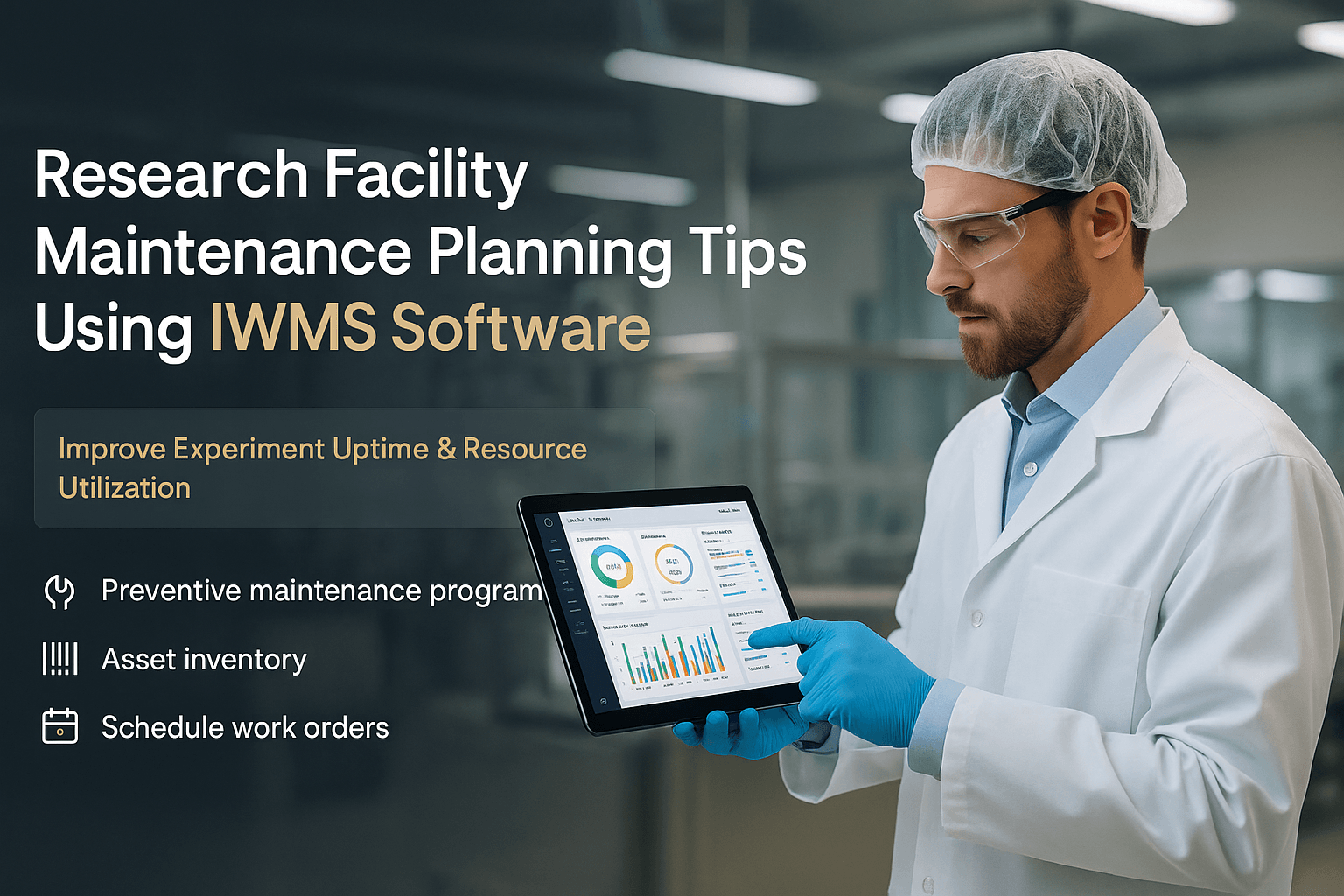
Using IWMS Software for preventive maintenance planning
Set up a preventive maintenance program
Start by inventorying critical equipment and ranking assets by research impact and risk—examples include biosafety cabinets, ultra-low freezers, and cleanroom HVAC. In IWMS Software, define standard tasks, frequencies, required procedures, and attach SOPs and SDS files for technician access.
- Use mixed triggers: calendar, runtime, and sensor thresholds.
- Attach calibration certificates and lockout/tagout notes to each asset record.
- Label assets with barcode or RFID for quick inventories and location checks.
Examples and business impact
Schedule compressor inspections for ultra-low freezers using runtime and calendar rules. Auto-create work orders from IoT temperature alarms to protect samples. The result: fewer emergency repairs, reduced sample loss, clearer warranty and calibration timelines, and lower replacement costs.
How can IWMS Software improve research facility maintenance planning?
IWMS Software consolidates asset, space, and maintenance records to prioritize safety- and research-critical equipment, trigger condition-based work orders, and automate preventive tasks. It reduces reactive repairs, preserves experiment uptime, and creates tamper-evident audit trails that simplify regulator and stakeholder reporting.
Facility asset tracking: best practices with IWMS Software
Build and maintain a centralized asset register
Capture serial numbers, warranty and calibration dates, vendor contacts, and full maintenance history. Store certificates, SOPs, and safety data sheets on each asset record so technicians and auditors can retrieve evidence instantly.
- Use barcode or RFID labels for fast inventories and location verification.
- Link asset records to procurement and ERP for warranty and spare-parts visibility.
- Sync IoT feeds to asset records so condition alerts generate automatic work orders.
Maintenance scheduling software features to prioritize work in research institutions
Prioritization frameworks
Categorize tasks as safety-critical, research-critical, or supporting systems. Score work by risk, potential downtime impact, and regulatory deadlines. Use IWMS Software scheduling to auto-rank work orders and flag high-priority items for rapid response.
Resource coordination
Match technicians by skill, certification, and lab clearance. Block maintenance windows around scheduled experiments to reduce disruption and ensure continuity of critical research activities.
Use case: for a BSL-2 suite, IWMS filters qualified technicians with required clearances and auto-assigns ventilation checks to prevent unauthorized access and experiment interruption.
Integrating IWMS into facility operations management and compliance
Data integration and single source of truth
Integrate IWMS with CMMS, BMS, and ERP to unify asset IDs and performance feeds. Establish data governance so IWMS Software is the authoritative source for maintenance, space, and access records and maintain tamper-evident audit trails for calibration and access events.
Compliance and audit readiness
Generate regulatory-ready reports quickly for institutional review boards, sponsors, and external inspectors. Centralized documentation demonstrates corrective actions, reduces audit risk for GLP/GMP environments, and speeds inspector responses.
Implementation roadmap for research facility managers
Stakeholder engagement and pilot approach
Identify stakeholders: lab managers, PIs, safety officers, procurement, and IT. Gather SLAs, access constraints, and experiment schedules. Pilot IWMS on a high-impact lab or equipment class to validate workflows and metrics.
- Train technicians on mobile IWMS apps for offline field access and parts consumption tracking.
- Measure pilot KPIs: reduction in reactive work, closed compliance gaps, and improved technician utilization.
- Create a governance committee to review MTBF, MTTR, and planned vs. reactive work.
Conclusion
Applying IWMS Software to preventive maintenance, centralized asset tracking, prioritized scheduling, and integrated systems creates a cohesive maintenance strategy for research facilities. The result: reduced downtime, stronger compliance, and better alignment between facilities and research teams—protecting experiments and institutional reputation.
Key Takeaways
- Centralize maintenance and space data in IWMS Software to enable structured preventive programs.
- Integrate IWMS with BMS, CMMS, and ERP to reduce reactive work and minimize experiment disruption.
- Phased rollout with stakeholder engagement, mobile tools, and governance improves adoption, ROI, and audit readiness.
Discover how eFACiLiTY can optimize your facility management. Schedule a demo today.
FAQ
How does IWMS Software differ from a traditional CMMS?
IWMS Software combines maintenance with space, occupancy, and real estate management, providing broader operational context than a CMMS. A CMMS focuses mainly on work orders and asset upkeep; IWMS links those activities to space planning, compliance workflows, and enterprise reporting for more strategic decision-making.
What maintenance KPIs should research facility managers track?
Track MTBF, MTTR, planned vs. reactive maintenance percentage, downtime hours for critical assets, calibration compliance rate, and work order backlog. These KPIs reveal equipment reliability, response performance, regulatory adherence, and maintenance team efficiency to guide data-driven resource allocation.
Can IWMS support regulatory and audit requirements for research labs?
Yes. IWMS Software stores calibration certificates, maintenance logs, access records, and SOPs with time-stamped, tamper-evident audit trails. It can generate inspection-ready reports, document corrective actions, and centralize evidence for institutional review boards, sponsors, and external regulators—reducing audit risk.




