
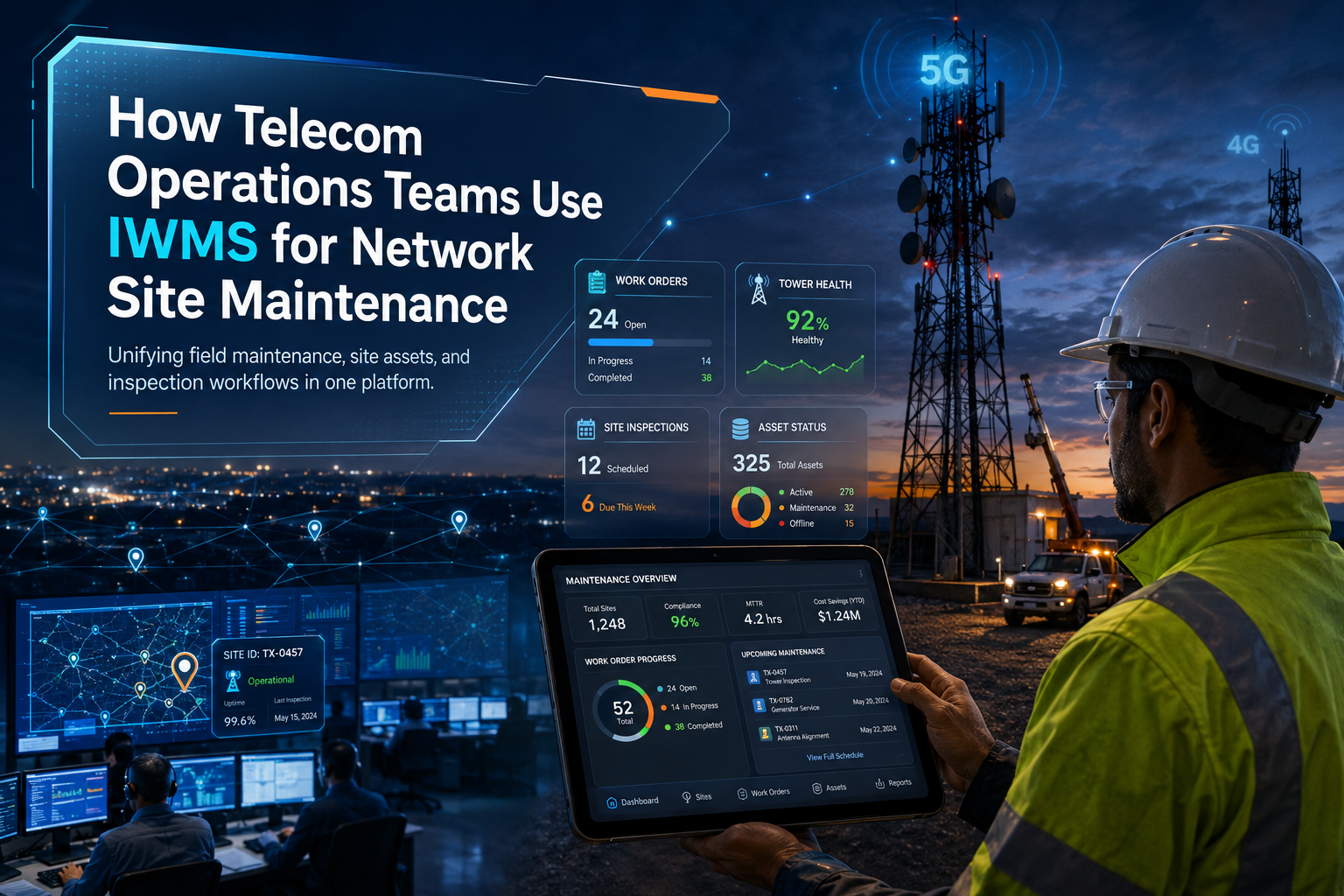
How does IWMS for network site maintenance support telecom operations teams?
An IWMS centralizes site and asset records, ingests telemetry and CMDB/OSS context, and automates preventive and condition-based maintenance with mobile work orders. This reduces reactive repairs, improves first-time-fix rates through better parts and documentation, and creates auditable trails for compliance and SLA reporting across distributed telecom estates.
IWMS for network site maintenance: capabilities that transform telecom facility management
Asset inventory and lifecycle management
An IWMS becomes the single source of truth for equipment, serial numbers, warranties and ownership across towers, huts and micro-POPs.
- Consolidated records to replace spreadsheets and siloed databases
- Lifecycle triggers and scheduled RFPs to plan end-of-life replacements
- Accurate capex forecasting and fewer surprise refreshes
Preventive and predictive maintenance
Built-in CMMS scheduling handles routine checks while APIs enable analytics-driven triggers.
- Battery health trends from telemetry generate automated replacement work orders
- Condition-based maintenance reduces unnecessary site visits and decreases reactive failures
Space, lease and power management
Track collocation details, rack space, power allocations and tenant contracts in one system to optimize utilization and revenue.
- Prevent power over-provisioning and lease breaches
- Resolve tenancy disputes faster with centralized records
Compliance, audit trails and reporting
Maintain inspection checklists, permits and technician certifications with searchable logs for rapid audit response and reduced fine exposure.
How IWMS improves field service coordination and technician workflows
Mobile-enabled work orders and dispatch
Push tasks to technicians with photos, signatures, wiring diagrams and spare-part lists attached to each ticket.
- Capture time logs and evidence on-device to shorten feedback loops
- Increase first-time-fix rates with consolidated site documentation
Workforce scheduling and SLA prioritization
Automate dispatch by SLA, severity and required skill set to send the nearest qualified resource and balance workloads.
Parts, inventory and spares management
Link spare parts to maintenance tasks, set reorder thresholds, and pre-stock trucks based on historical failure patterns to reduce repeat visits.
Safety and onsite compliance checklists
Embed safety workflows and permit checks into work orders so technicians must complete required steps before unsafe interventions proceed.
Proactive network infrastructure maintenance and remote site monitoring
Integration with telemetry and remote sensors
Ingest alarms, environmental sensors and power telemetry into IWMS dashboards so events create prioritized tickets for NOC and field teams.
Predictive maintenance through analytics
Combine historical failure logs with live sensor feeds to predict failures and shift from calendar-based to condition-based maintenance, reducing OPEX and extending equipment life.
Centralized dashboards, alerting and GIS/CMDB linkage
Provide unified visibility across towers, huts and data centers. Link IWMS records to GIS and CMDB/OSS for routing optimization and faster incident restoration.
Measuring ROI: cost, uptime, and compliance benefits of IWMS
Track concrete KPIs to quantify benefits and inform continuous improvement.
- Truck rolls per ticket and cost per site
- Preventive vs reactive maintenance ratio
- MTTR, uptime and SLA attainment
- Audit preparation time and documentation completeness
Compare cloud vs on-premise TCO when planning regional rollouts; cloud typically accelerates integrations with OSS, GIS and telemetry platforms.
Conclusion
IWMS provides a strategic platform to centralize telecom facility management, automate maintenance, and coordinate field teams. Operations leaders gain measurable outcomes—fewer outages, lower operating costs, improved compliance, and scalable processes to support network expansion and technology upgrades.
Key Takeaways
- IWMS unifies asset, maintenance and compliance data to enable proactive network infrastructure maintenance.
- Mobile work orders and telemetry integrations reduce truck rolls and improve field coordination.
- Measure ROI through MTTR, truck rolls, preventive vs reactive ratios, and audit efficiency.
Discover how eFACiLiTY can optimize your facility management with IWMS.
Schedule a demo today.
FAQ
How quickly can IWMS start reducing downtime for telecom sites?
With a focused pilot that integrates core asset data and mobile work orders, teams often see reduced truck rolls and faster responses within three to six months. Full benefits—predictive analytics and telemetry-driven automation—grow as integrations mature and data quality improves across the estate.
Can IWMS integrate with existing OSS, CMDB or remote monitoring tools?
Yes. Modern IWMS platforms provide REST APIs and prebuilt connectors for OSS/BSS, CMDB, GIS and telemetry systems. Integrations synchronize records, enable alarm-to-ticket automation, and enrich site context for both NOC and field operations without replacing core telecom systems.
What KPIs should operations heads track after IWMS deployment?
Track MTTR, truck rolls per ticket, preventive vs reactive maintenance ratio, uptime/SLA attainment, parts turnover, and audit completion time. These KPIs quantify operational improvements, guide continuous refinement, and demonstrate ROI to stakeholders and commercial teams.




