
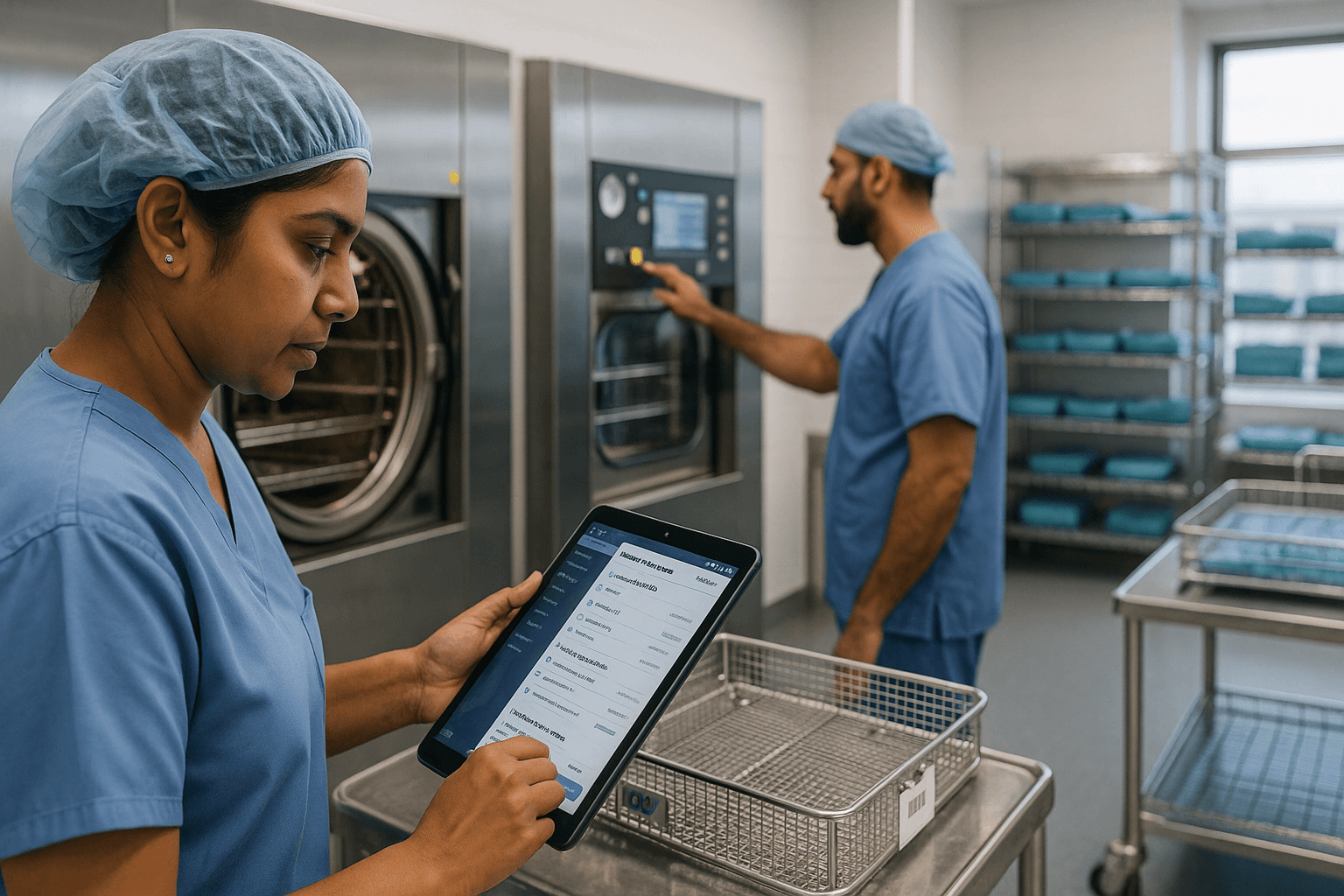
How does facilities management software for sterilization workflows improve ROI?
Facilities management software for sterilization workflows centralizes asset and inventory data, automates preventive maintenance and sterilizer cycle logging, and links operational KPIs to finance. By reducing emergency repairs, improving throughput, and providing audit-ready evidence, it often delivers measurable ROI within 12–24 months.
Core modules to prioritize
Asset & inventory tracking
Tag sterilizers, autoclaves, instrument trays, and key consumables with barcode or RFID. Track location, cycle counts, and maintenance history to minimize lost sets and reduce unnecessary capital purchases.
Preventive maintenance & automated work orders
Schedule calibrations, enforce PM intervals, and auto-create work orders when thresholds or error codes occur. Mobile execution and time-stamped closures cut reactive service calls and after-hours emergency repairs.
Sterilization cycle logging & integrations
Capture cycle parameters, temperatures, and cycle IDs directly from sterilizer controllers. Integrate with EHR/LIS to map cycles to patient cases for traceability and rapid root-cause analysis.
- Business impact: higher sterilizer uptime and fewer emergency repairs.
- Traceability: cycle-to-patient mapping reduces liability and rework.
- Efficiency: better utilization and fewer duplicate instrument purchases.
Facilities management software for sterilization workflows: reporting, analytics, and integrations
Reporting & dashboards
Use custom dashboards to monitor tray-to-tray turnaround, uptime, cost per cycle, MTBF, and utilization. Automated compliance reports produce accreditation-ready evidence packs for JCI/ISO audits.
Integration capabilities
Connect with EHR/LIS to associate sterilization cycles with case IDs. Combine barcode/RFID scanning and mobile technician workflows so staff receive prioritized tasks, scan parts, and close work orders with time-stamped signatures.
- Reduce transcription errors and shorten repair resolution times.
- Improve parts traceability and warranty claim handling.
- Enable KPI-driven capacity planning tied to surgical schedules.
Measuring sterilization ROI: key facility performance metrics
Operational KPIs
- Turnaround time (tray-to-tray): aim for 10–30% reductions.
- Instrument utilization & throughput: align capacity to case mix.
- Mean time between failures (MTBF) and mean time to repair (MTTR).
Financial & compliance KPIs
- Cost per sterilization cycle (energy, water, consumables, labor, maintenance).
- Emergency repair spend and replacement rate reductions.
- Cycle pass/fail rates and documentation completeness for audits.
How maintenance task tracking reduces downtime and cost
Preventive vs. reactive maintenance model
Shift from reactive fixes to scheduled preventive maintenance to increase MTBF and lower MTTR. Baseline failure modes, define PM tasks and intervals, and automate reminders to enforce timely execution.
Maintenance workflow
Automated alerts (cycle counts, error codes), mobile work-order execution, and parts consumption logging enable faster repairs and better vendor/warranty management—reducing out-of-pocket costs and overtime.
Facility cost control strategies using software
Direct cost controls
Track consumables, optimize load scheduling, and batch non-urgent cycles during off-peak hours to reduce utility spend and cost per cycle.
Lifecycle cost management
Use TCO dashboards and predictive replacement planning based on usage and failure trends to defer unnecessary capital purchases and plan budget cycles more accurately.
Budgeting & chargeback models
Allocate sterilization costs to departments or procedures with transparent chargebacks to incentivize efficient use and create a replenishment funding stream for instrument sets.
Ensuring audit-ready sterilization: compliance management and reporting
Regulatory alignment
Map time-stamped cycle logs, PM histories, and corrective-action records to JCI, ISO, and local regulations. Preconfigure report templates to match audit checklists and retention windows.
Audit trails & best practices
Enforce role-based authentication, immutable logs, and electronic signatures. Maintain stored evidence packs for typical audit windows (3–5 years) and run periodic pre-audit checks.
Implementation roadmap: from pilot to enterprise deployment
Phase 1 — Assess & define success metrics
Establish baselines for turnaround time, emergency repair spend, and compliance gaps. Map stakeholders: sterile processing, clinical engineering, procurement, and administration.
Phase 2 — Pilot & integrate
Select a pilot unit, integrate sterilizers and inventory systems, train technicians on mobile workflows, and validate KPIs within 3–6 months.
Phase 3 — Scale & optimize
Roll out across sites, use KPI-driven refinements, enforce governance, and maintain vendor partnerships for continuous improvement.
Conclusion
Facilities management software focused on sterilization workflows centralizes assets, automates maintenance, and delivers audit-ready evidence—reducing downtime, improving throughput, and lowering lifecycle costs. Pair software capabilities with clear KPIs and a phased rollout to convert operational improvements into demonstrable financial ROI.
Key Takeaways
- Centralize sterilization operations to reduce downtime and replacement costs.
- Track performance and maintenance to convert operational gains into financial impact.
- Use integrations and audit-ready reporting to sustain compliance and efficiency.
Discover how eFACiLiTY can optimize your facility management. Schedule a demo today.
FAQ
What ROI can hospitals expect from facilities management software for sterilization workflows?
ROI varies by baseline inefficiency, but typical outcomes include 10–30% reductions in emergency repairs, 15–25% lower instrument replacement spend, and throughput and compliance gains that often produce payback within 12–24 months of deployment.
How quickly can maintenance task tracking reduce sterilization equipment downtime?
With automated scheduling, mobile work-order execution, and parts visibility, many hospitals see measurable downtime reductions within 3–6 months as preventive maintenance replaces reactive fixes and MTBF improves, reducing after-hours calls and emergency repairs.
Will facilities management software support regulatory compliance and audit needs?
Yes. Modern systems capture sterilization cycle logs, enforce authenticated user actions, and produce configurable, audit-ready reports aligned with JCI, ISO, and local regulations—enabling evidence packs, continuous monitoring, and fewer audit findings.




