
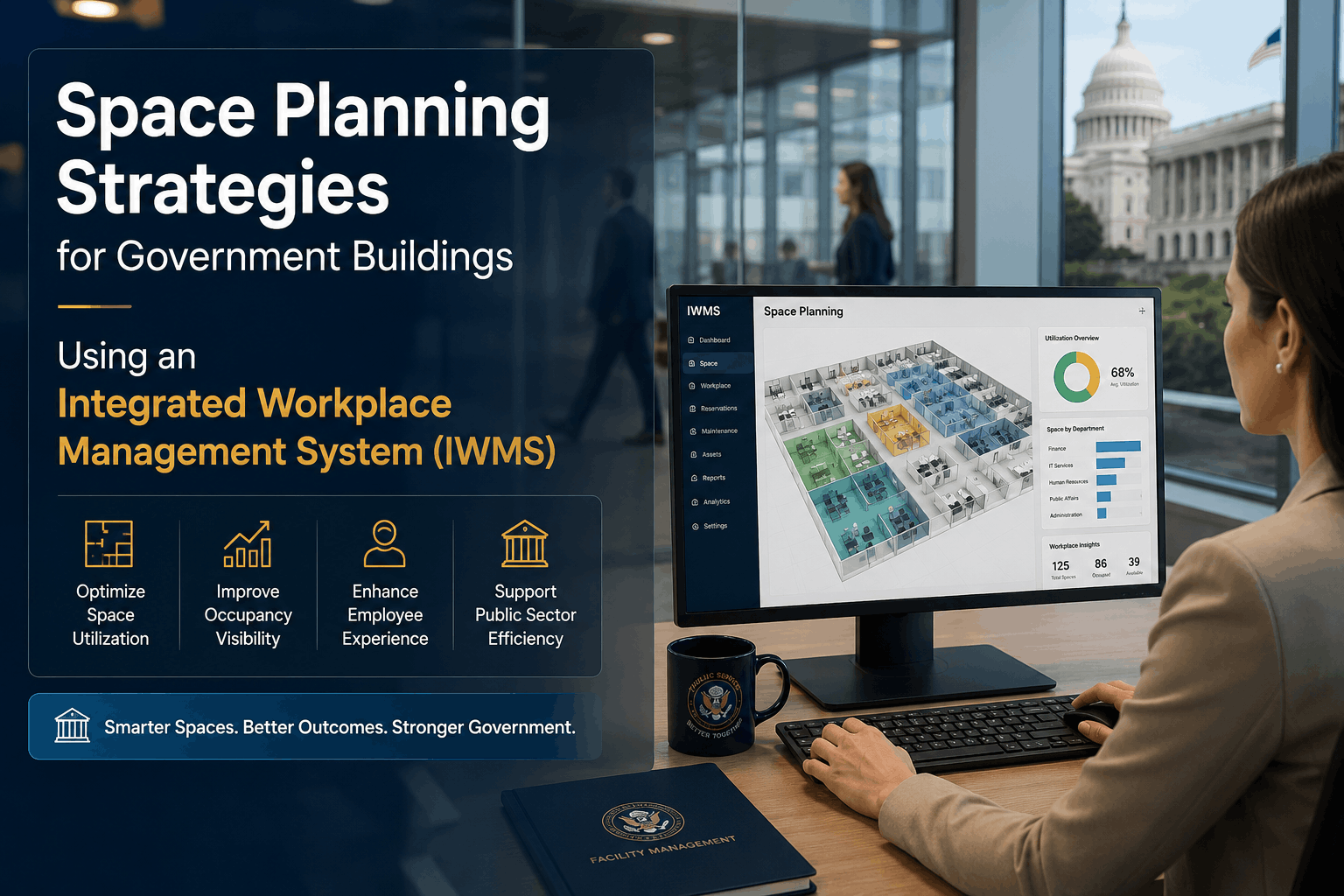
How does an integrated workplace management system (IWMS) support space planning in government buildings?
An integrated workplace management system (IWMS) consolidates authoritative records, integrates sensors, badge and booking data, and applies rules-based allocations. It enables scenario modelling, enforces accessibility and security constraints, automates preventive maintenance, and produces exportable audit trails so agencies can make defensible, cost-saving portfolio decisions.
Operational and financial benefits of an integrated workplace management system (IWMS)
Rightsizing and lease optimisation
Use sensor, booking, and HR feeds to identify underused areas and vacancy trends. Combine analytics with lease data to time renewals or exit strategies and reduce cost per square metre.
Reduced operational costs
- Preventive maintenance scheduling lowers reactive repairs and MTTR.
- Consolidated vendor management reduces procurement complexity and costs.
- Automated workflows cut manual reconciliation and administrative overhead.
Auditability and stewardship
A single source of truth for assets, leases, and moves produces exportable reports that simplify stewardship reviews and compliance audits.
Step-by-step space planning framework for public sector facility management
1. Baseline assessment
Build an authoritative inventory: CAD/BIM floor plans, CAFM asset registers, and lease records. Integrate HR headcount, badge access, sensors, and calendar/booking systems into the IWMS to eliminate reconciliation errors.
2. Define policy and targets
Translate regulations, union agreements, accessibility and security rules into allocation policies. Define utilization and density targets and label seats as permanent or flexible within the IWMS rules engine.
3. Model scenarios and pilot
Run scenario modelling for consolidation, hot-desking, and satellite options. Pilot to validate booking behaviour, peak demand, and IT/security interactions before a broad rollout.
4. Implement and iterate
Deploy IWMS-driven workflows, monitor KPIs, maintain change logs, and collect stakeholder feedback—facilities, HR, unions, and IT—to refine rules and processes.
Workplace occupancy planning: data sources, analytics, and forecasting
Key data inputs
- Sensors and badge access logs for actual occupancy patterns.
- Room booking and calendar systems for intent and scheduled use.
- HR systems for headcount, role mapping, and accommodations.
- CAFM/maintenance schedules for availability constraints.
Analytics and forecasting techniques
Apply time-series analysis, heatmaps, and peak-period studies to reveal patterns. Build predictive models using historical desk and booking data to drive phased moves and lease-renewal planning.
Office allocation software and change management for government environments
Allocation strategies and rules engine
Implement role-based and function-based policies that enforce clearance, security zones, and accessibility. Automate desk assignments, waitlists, and exception reporting for oversight.
Stakeholder engagement and training
Engage unions, program leads, IT, and security early. Provide clear training and self-service tools for booking, accommodations, and exception requests to increase adoption and reduce support calls.
Governance and policy enforcement
Define escalation paths and exceptions inside the IWMS. Use automated logs and scheduled exports for compliance reviews and audit trails.
Measuring success: KPIs, reporting, and compliance for government buildings
Operational KPIs
- Utilization rate, vacancy rate, and move frequency.
- Cost per square metre, maintenance backlog, and MTTR.
Financial and compliance metrics
Track realised savings from rightsizing and lease optimisation. Maintain regulatory dashboards and exportable audit reports for stewardship reviews.
Conclusion
Strategic space planning for government buildings combines policy, authoritative data, scenario modelling, and governance. An IWMS centralizes datasets, automates workflows, and provides the audit trails needed to translate strategy into measurable outcomes while meeting public-sector compliance and user-experience requirements.
Key Takeaways
- Use an authoritative inventory and scenario modelling to guide consolidation and allocations.
- Integrate occupancy sources (sensors, booking, HR) via an IWMS for defensible planning.
- Pair allocation software with governance and change management to ensure adoption.
Discover how eFACiLiTY can optimize your facility management with an integrated workplace management system. Schedule a demo to see IWMS-driven space planning in action.
FAQ
What are the first steps to start space planning with an integrated workplace management system?
Start by creating an authoritative inventory of spaces, assets, and leases and integrate HR, booking, sensor, and badge-access feeds into the IWMS. Define allocation policies, run a small pilot to validate assumptions, measure utilization KPIs, and use findings to refine rules before broader rollout to minimize disruption.
How does workplace occupancy planning reduce real estate costs for government agencies?
Occupancy planning exposes underused space and peak-demand patterns through sensor, booking, and HR data. Agencies can target consolidation, optimize lease renewals, and schedule forecast-driven phased moves to reduce vacancy and transition costs. These actions lower cost per square metre while preserving service continuity and mission delivery.
Is office allocation software compliant with public sector procurement and security requirements?
Yes. Select IWMS vendors with public-sector references, documented security controls, role-based access, and exportable audit logs. Ensure contracts specify data residency, audit provisions, and integration with legacy systems. Include procurement and IT/security teams in vendor evaluation to validate compliance requirements and obtain required certifications before deployment.




