
Overview
Centralized scheduling systems orchestrate rooms, benches, and core instruments to enforce policies, manage access, and provide utilization analytics. This creates operational visibility that helps managers eliminate time sinks, coordinate cross-team workflows, and align maintenance windows with low-demand periods.
How does space booking software reduce lab scheduling bottlenecks for R&D teams?
Space booking software consolidates reservations, prevents double-bookings, and enforces resource-specific rules (cleanup buffers, training prerequisites, and operator availability). Together with sensor and access integrations, it automates approvals, reduces no-shows, and surfaces utilization data managers use to reallocate capacity and shorten experiment wait times.
Key benefits of space booking software for R&D facilities
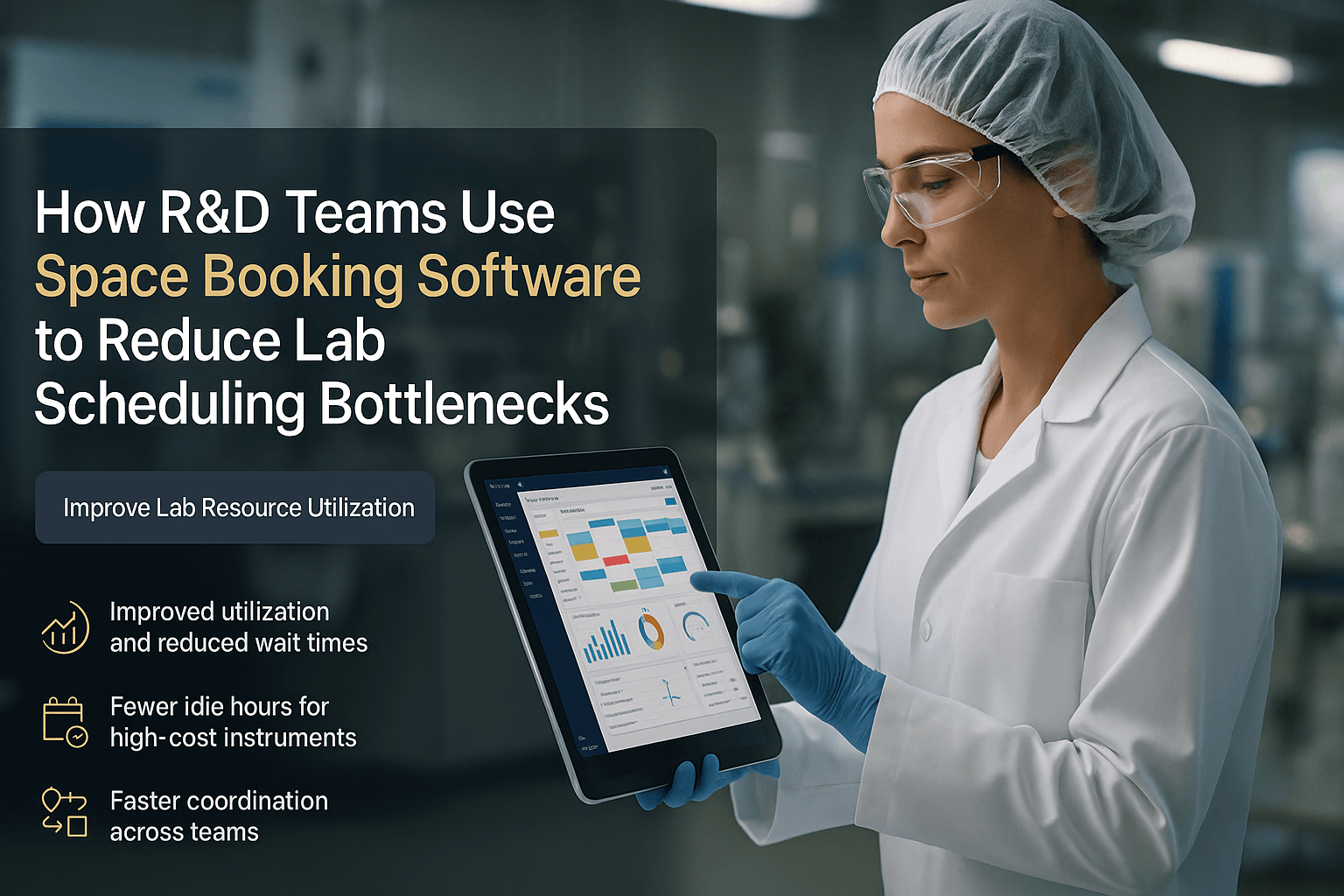
Improved utilization and reduced wait times
Real-time availability and resource-aware rules shrink idle gaps between experiments. Analytics reveal underused assets, enabling consolidation or rescheduling of maintenance during low-demand windows.
- Fewer idle hours for high-cost instruments
- Faster experiment starts and higher throughput
- Reduced capital spend through deferred purchases
Faster coordination across teams
Shared calendars, project tags, and sequence planning automate downstream reservations (for example, reserving a prep bench after a sample run), improving handoffs for multi-step protocols.
- Automated notifications reduce no-shows
- Cross-team visibility for dependent workflows
- Improved on-time starts for assays and validation runs
Essential features to look for in space booking software
Calendar integrations and conflict management
Two-way sync with Outlook and Google Calendar prevents overlaps. Auto-blocking for contiguous bookings, mandatory cleanup windows, and conflict alerts reduce manual negotiation and scheduling overhead.
Equipment reservation tools and access controls
Look for resource-specific booking (benches, hoods, instruments), conditional rules (training, PPE), and role-based permissions. Conditional approvals and audit trails enforce compliance and operator safety.
Automation, sensors, and reporting
Occupancy sensors and door-controller integrations clear phantom bookings and can trigger automatic unlocks for scheduled users. Reporting dashboards show utilization, maintenance needs, and predictive servicing to reduce unexpected downtime.
Step-by-step implementation of research facility booking systems
Planning and stakeholder alignment
Inventory spaces, list equipment, map user roles, and define booking policies and SLAs. Hold stakeholder workshops to align rules with lab practice and secure buy-in.
Pilot, iterate, and train
Pilot a high-impact resource for 4–8 weeks, collect usage data and feedback, then refine buffers and approval flows. Deliver short role-based training and quick reference guides to accelerate adoption.
Integration and technical rollout
Integrate with identity/authentication, access control, and LIMS/PMS systems. Use APIs to trigger LIMS entries or door unlocks based on bookings, and roll out in phases to validate end-to-end workflows.
Leveraging IWMS, CAFM, and EAM for better outcomes
Enterprise platforms enhance scheduling: EAM automates preventive maintenance that blocks equipment slots, IWMS produces space utilization reports to justify capital decisions, and CAFM centralizes facility operations to reduce duplicate data entry. Integration shortens lead times and improves maintenance coordination.
Best practices and use cases: minimizing lab scheduling bottlenecks
Shared equipment scheduling
Standardize time blocks, cleanup buffers, and maintenance windows. Use pre-book checks for training and consumables, allow project-based holds, and enable recurring contiguous reservations for long experiments.
Managing peaks and temporary capacity
Apply dynamic booking limits during deadlines, reserve contingency slots for urgent work, and use waitlists that auto-assign freed slots. Flexible shared spaces and hot-desking can absorb temporary demand for low-risk workflows.
Measuring ROI, compliance, and performance
KPIs to track
- Utilization rate
- Average booking lead time
- No-show rate
- Instrument downtime
- Administrative hours spent scheduling
Cost and time savings
Translate reduced idle hours and administrative labor into shorter project timelines. Even modest utilization gains across expensive instruments often yield measurable ROI within a year and can defer capital purchases.
Compliance and traceability
Centralized booking logs create audit-ready trails, enforce prerequisites for safety, and simplify incident investigations, reducing regulatory risk and improving accountability.
Conclusion
Adopting a purpose-built space booking solution transforms fragmented scheduling into governed, automated workflows. R&D managers gain visibility, reduce bottlenecks, and improve throughput for costly instruments while maintaining compliance and lowering operational costs.
Key Takeaways
- Centralized booking eliminates double-bookings and reduces idle equipment time.
- Integrations (calendar, sensors, LIMS, access control) automate approvals and traceability.
- Phased implementation, KPIs, and stakeholder alignment ensure measurable adoption and ROI.
Discover how eFACiLiTY can optimize your facility management. Schedule a demo today.
FAQ
How is a space booking app different from traditional calendar sharing?
A space booking app enforces resource-specific rules, prevents conflicts, supports conditional approvals, integrates with sensors, and provides analytics. Unlike simple calendar sharing, it manages permissions, training prerequisites, buffers, and audit trails—turning informal bookings into governed operational workflows that scale.
Can laboratory scheduling software integrate with access control and LIMS?
Yes. Modern platforms offer APIs and connectors to sync authentication, door locks, LIMS entries, and instrument control systems. Integration enables automated door unlocks for scheduled users, booking-triggered LIMS logging, and centralized audit trails for traceability and regulatory compliance.
What KPIs should R&D managers monitor after deploying a space booking app?
Track utilization rate, average booking lead time, no-show rate, instrument downtime, and administrative scheduling hours. These metrics quantify operational improvements, reveal bottlenecks, and support data-driven decisions on capacity, maintenance scheduling, and staffing.




