
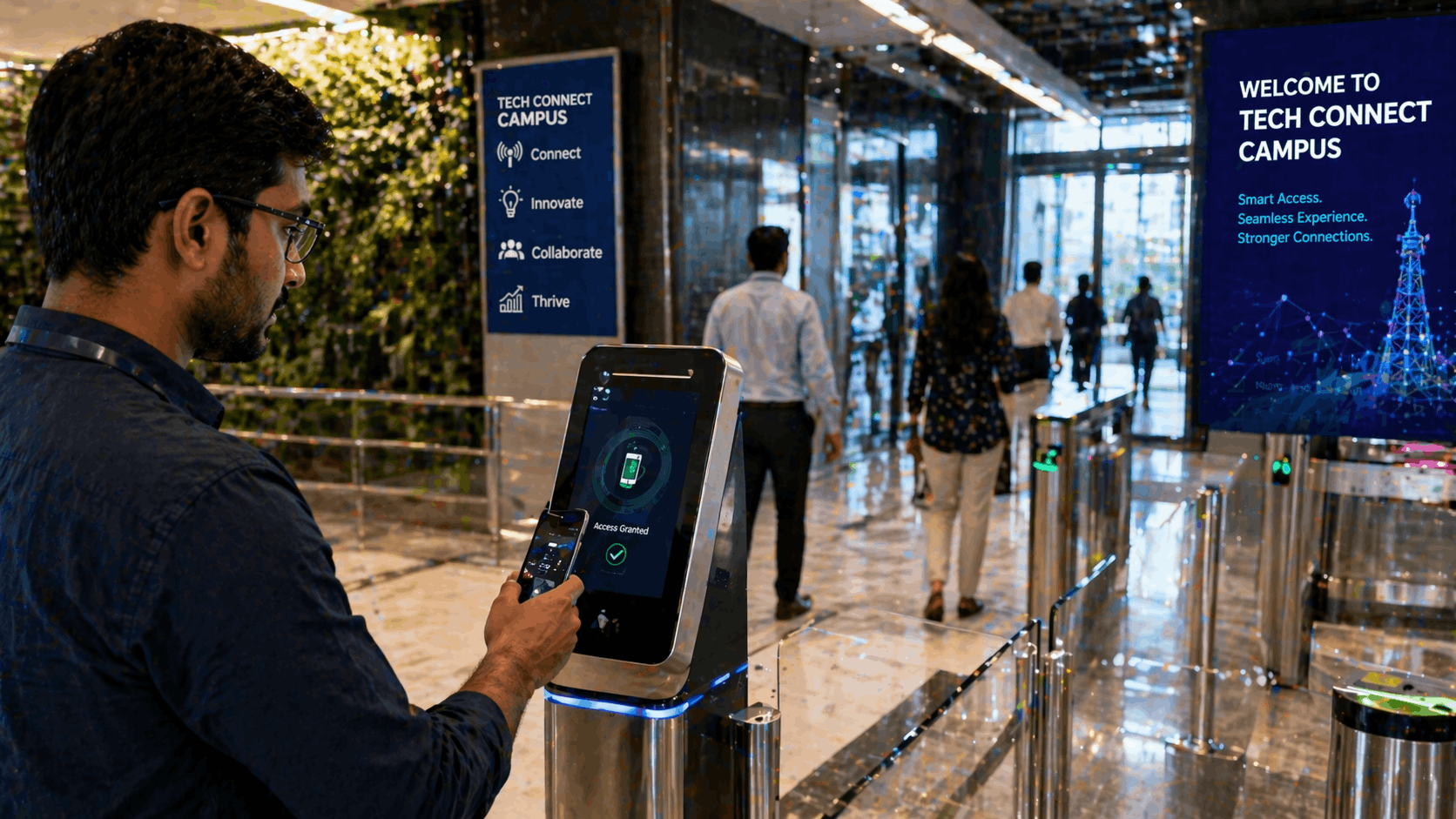
How does integrated workplace management software streamline campus access for telecom tech leads?
Integrated workplace management software centralizes identity, access control, and asset records to automate role-based provisioning, issue time-bound credentials, and correlate door logs with NMS alerts. That automation cuts coordination time, reduces MTTR, and produces searchable, auditable trails tying access events to equipment and incident tickets.
Why telecom tech leads need integrated workplace management software
Unified visibility
Single map of buildings, racks, and access points links physical locations to CMDB and NMS entries, removing duplicate inventories and enabling faster troubleshooting.
Faster fieldwork
- Template-based role provisioning for engineers and contractors
- Time-limited credentials and automated revocation from HR/IdP events
- Pre-authorized access windows tied to tickets
Compliance-ready logs
Time-stamped access histories, CCTV metadata, and asset change logs are correlated for audits and incident investigations—reducing forensic assembly time from days to hours.
How to implement IWMS for campus access: step-by-step playbook for Tech Leads
Phase 1 — Assess and define scope
- Inventory buildings, doors, critical network endpoints, and existing ACS
- Map integrations: IdP/SSO, ACS, CMDB, NMS, HR/payroll
- Define success criteria: provisioning time, MTTR, audit-readiness
Phase 2 — Requirements and vendor shortlist
- Must-haves: role-based access, audit trails, API-first architecture, occupancy analytics
- Confirm lease management and capital planning capabilities if needed
Phase 3 — Integration and rollout
- Pilot one campus with representative workflows
- Integrate IdP, ACS, NMS, and automate CMDB reconciliation
- Train teams, monitor KPIs, iterate on workflows
Key features to evaluate in an integrated workplace management software
Access control & identity orchestration
Role-based provisioning, temporary credentials, time-bound access, and MFA integration with APIs for automated revocation from HR/IdP changes.
Occupancy analytics and space optimization
Real-time utilization dashboards for maintenance scheduling, hot-desking, and identifying low-occupancy windows for disruptive work.
Lease management and capital planning
Centralized lease records, CAPEX modeling, depreciation schedules, and asset refresh planning tied to network equipment lifecycles.
Measuring ROI and operational KPIs for IWMS deployments
Operational KPIs
- Access provisioning time
- Mean time to repair (MTTR)
- Unauthorized access incidents
- Space utilization
Financial KPIs
Lease cost per sqm, savings from system consolidation, and deferred CAPEX via planned refresh cycles. Use weekly ops dashboards and quarterly strategic reviews to link IWMS insights to network capacity planning.
Common pitfalls and best practices
- Avoid heavy customization; prefer configuration and API extensions to preserve upgrades
- Assign cross-functional governance across facilities, security, and network teams
- Automate identity lifecycle with IdP and HR integrations to avoid stale privileges
- Start with a pilot and measurable success criteria
Conclusion
For telecom tech leads, integrated workplace management software is the operational plane connecting access control, asset location, occupancy analytics, and financial planning. With clear scope, API-first integrations, and KPI-driven rollouts, IWMS reduces downtime, improves compliance, and aligns facilities with network goals.
Key Takeaways
- Centralize access control, occupancy analytics, lease tracking, and capital planning
- Start with a pilot; prioritize IdP, CMDB, and NMS integrations
- Enforce least-privilege access and maintain a shared data model for audits
Discover how eFACiLiTY can optimize your facility management. Schedule a demo today.
FAQ
What integrations are essential between IWMS and telecom systems?
Essential integrations include identity providers (SSO/IdP), access control systems (ACS), CMDB/NMS, and HR/payroll. These automate provisioning/deprovisioning, reconcile assets, and trigger incident workflows—reducing manual handoffs and ensuring access changes propagate securely across systems for faster repairs and cleaner audits.
How long does a typical IWMS campus rollout take for a telecom provider?
Pilot implementations typically take 8–12 weeks. Full rollouts vary by scope and integrations and commonly take 4–9 months, accounting for ACS integrations, CMDB reconciliation, and change management across facilities, security, and network teams. Complex campuses or custom workflows may extend timelines.
Can an IWMS handle lease management and capital planning for multiple sites?
Yes. Modern IWMS platforms include or integrate lease management and capital planning to centralize lease data, model CAPEX, and align refresh cycles with telecom assets—enabling better site consolidation, lifecycle budgeting, and reduced surprise spend across multiple campuses.




