
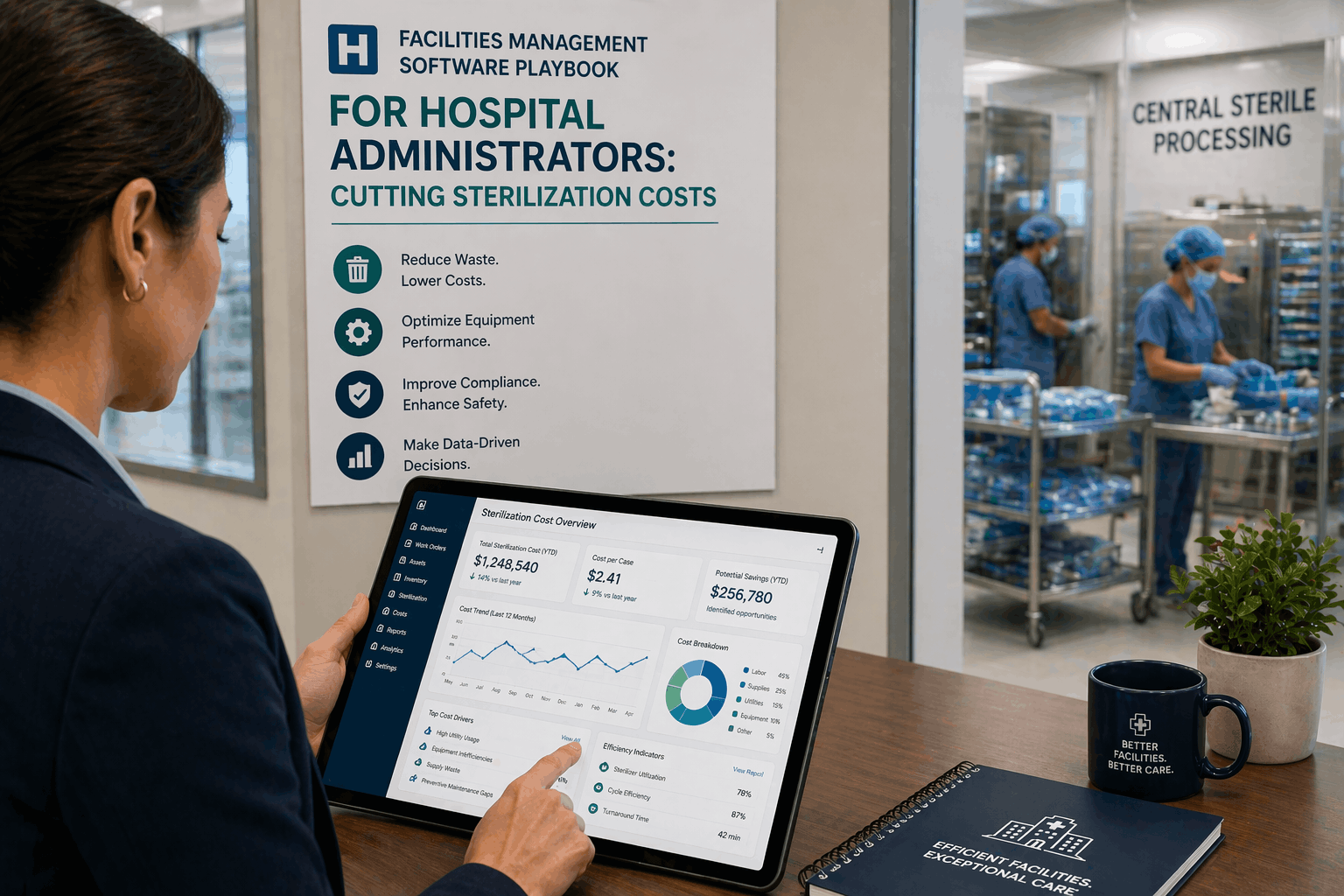
Sterilization costs are a growing burden for hospitals and clinics, driven by consumables, equipment downtime, labor-intensive reprocessing, and compliance overhead. A centralized facilities management software platform (IWMS/CAFM/EAM) links asset lifecycle, preventive maintenance, consumable tracking, and vendor workflows to turn hidden inefficiencies into measurable savings without sacrificing patient safety.
How can facilities management software reduce sterilization costs in hospitals?
Facilities management software reduces sterilization costs by optimizing sterilizer schedules, automating preventive maintenance, and tracking consumables with reorder rules. Centralized workorders and vendor management lower emergency repairs, overtime, and rush purchasing. These changes convert hidden inefficiencies into measurable savings without compromising sterilization quality or compliance.
Why sterilization costs escalate in hospitals
Common cost drivers
Several operational and supply-side factors push sterilization costs higher:
- High instrument turnover and frequent reprocessing increase consumable use (wrappings, indicators, sterilant).
- Unplanned equipment failures (sterilizers, washers) cause emergency repairs, overtime, and cancelled procedures.
- Stockouts force rush orders with premium freight and expedite fees.
- Reactive staffing and fragmented workflows drive inefficient labor costs.
Regulatory and compliance pressure
Accreditations demand traceability, validation logs, and audit trails. Manual records increase administrative labor and citation risk. Digital traceability in a facilities management platform shortens inspection prep, centralizes calibration logs, and reduces documentation time while improving audit readiness.
Operational silos that hide savings opportunities
Clinical, CSSD, and facilities teams often work in separate systems, obscuring cause-and-effect relationships like instrument shortages prompting repeated reprocessing. Cross-functional scheduling and shared KPIs reveal redundant cycles, waste, and opportunities for immediate savings.
How facilities management software reduces sterilization costs
Optimizing schedules with facility operations management
Align sterilization cycles with OR case lists to smooth peaks and reduce rush sterilization. Demand-driven cleaning schedules avoid unnecessary reprocessing and minimize consumable burn. Coordinated room and equipment availability lowers idle time and overtime.
Preventive maintenance using maintenance planning tools
Automated PMs for sterilizers and washers reduce emergency downtime. Predictive alerts based on telemetry or usage hours enable planned repairs, shorten MTTR, and can defer capital replacement through better lifecycle maintenance.
Tracking consumables and building service tracking
Real-time dashboards show consumable burn rates, expiry risk, and per-procedure usage. Reorder thresholds and automated procurement prevent stockouts and waste. Linking consumption to procedure types enables per-procedure budgeting and variance analysis.
Improve vendor service management and accountability
Centralize contracts, SLAs, and service logs to reduce repeat visits and overbilling. Automate workorder-to-invoice matching and use vendor scorecards to drive performance improvements and renegotiation leverage.
Key features hospital administrators must require
Asset and sterilizer lifecycle management
- Serial-level asset tracking, calibration logs, and complete service history for traceability and capital planning.
- Telemetry integration for usage-based predictive alerts.
Workorder and maintenance planning tools
- Recurring task templates, prioritization rules, and a mobile technician app with photo and signature capture.
- Mobile capture speeds fixes and improves labor costing transparency.
Vendor service management and contract integration
- SLA monitoring, automated invoice matching, and vendor scorecards to reduce surprises and repeat work.
Building service tracking and audit trails
- Real-time cleaning status, validated sterilization cycle logs, and dashboard alerts to reduce inspection prep time.
Implementation roadmap: pilot to enterprise rollout
Phase 1 — Discovery and baseline costing
Map CSSD workflows, identify high-cost instruments, and collect baseline spend for consumables, labor, and repairs. Establish KPIs for later comparison.
Phase 2 — Pilot deployment and KPIs
Pilot in 1–2 areas (for example central sterile and a busy OR). Configure maintenance planning, set KPIs such as equipment uptime, consumable spend, and reprocessing events, and measure early wins.
Phase 3 — Scale and integrate with clinical systems
Integrate with EHR/sterilization logs, procurement, and finance for end-to-end visibility and to enable automated chargebacks or departmental billing.
Phase 4 — Continuous improvement
Use dashboards and vendor metrics to refine schedules and contracts. Conduct monthly reviews to capture incremental savings and update SLAs based on performance data.
Measuring ROI, compliance, and vendor performance
Key metrics to track
- Sterilization cost per procedure
- Equipment uptime, MTBF and MTTR
- Emergency repair frequency and vendor SLA adherence
- Consumable burn rate and stockout events
Financial models and break-even analysis
Model labor savings from reduced overtime, consumable reductions (typical 10–25%), and deferred capital. Focused pilots commonly reach break-even within 6–12 months depending on baseline inefficiency.
Auditability and regulatory readiness
Digital logs and building service tracking simplify inspections, reduce administrative time, and lower citation risk—supporting accreditation readiness and operational transparency.
Case uses and quick wins
CSSD use case
Shift to demand-driven cycles, track consumables per case, and reduce repeated reprocessing. Result: lower consumable spend, faster turnaround, and improved throughput.
Outpatient surgical center use case
Coordinate case schedules with sterilizer capacity and maintenance windows to reduce overtime and increase throughput for same-day procedures.
30–90 day quick wins
- Deploy a mobile workorder app for technicians.
- Set reorder points for critical consumables.
- Standardize vendor SLAs and start automated invoice matching.
Conclusion
Facilities management software that integrates IWMS/CAFM/EAM functionality delivers measurable reductions in sterilization costs by improving scheduling, preventive maintenance, consumable control, and vendor oversight. A measured pilot, clear KPIs, and phased scaling provide the fastest path to sustainable savings while maintaining regulatory compliance and safety.
Key Takeaways
- Centralize maintenance, asset, and vendor workflows to reduce sterilization costs and operational risk.
- Prioritize maintenance planning tools, building service tracking, and vendor service management for immediate impact.
- Pilot, measure, and scale with clear KPIs to demonstrate ROI within months.
Discover how eFACiLiTY can optimize your facility management.
Schedule a demo today.
FAQ
How much can hospitals typically save on sterilization with facilities management software?
Hospitals commonly see 10–25% reductions in consumable spend, 20–40% fewer emergency repairs, and meaningful labor-hour savings from optimized scheduling. Actual savings depend on baseline inefficiencies; focused pilots typically validate these ranges within 3–9 months when KPIs are tracked.
What maintenance planning tools are essential for reducing sterilization downtime?
Essential tools include automated preventive maintenance schedules, a mobile technician app, predictive alerts from asset telemetry, and integration with historical service data. Together these reduce emergency downtime, shorten MTTR, extend asset life, and lower repair costs.
How does facilities management software improve vendor service management?
It centralizes contracts and service logs, enforces SLAs, automates workorder-to-invoice matching, and provides performance dashboards. This reduces repeat visits, prevents overbilling, and creates data-driven leverage for renegotiations based on measurable vendor performance.




