Facility and workplace management have never lacked systems. What it has consistently lacked is time.
Across large and complex environments, facility teams operate under constant pressure. Requests arrive continuously. Assets age. Compliance expectations increase. Yet, despite years of investment in CAFM and IWMS platforms, much of the work still depends on people coordinating manually across tools, teams, and locations.
That invisible coordination effort is where cost, delay, and operational risk quietly accumulate. Industry research consistently shows that a significant share of operational time is absorbed by low-value activities such as manual coordination, follow-ups, and inefficient hand-offs, with more than two-thirds of workers reporting that they regularly spend time on such tasks rather than on high-impact work. At scale, this gap translates into higher operating costs, slower decision cycles, and increased exposure during audits, outages, and peak demand periods.
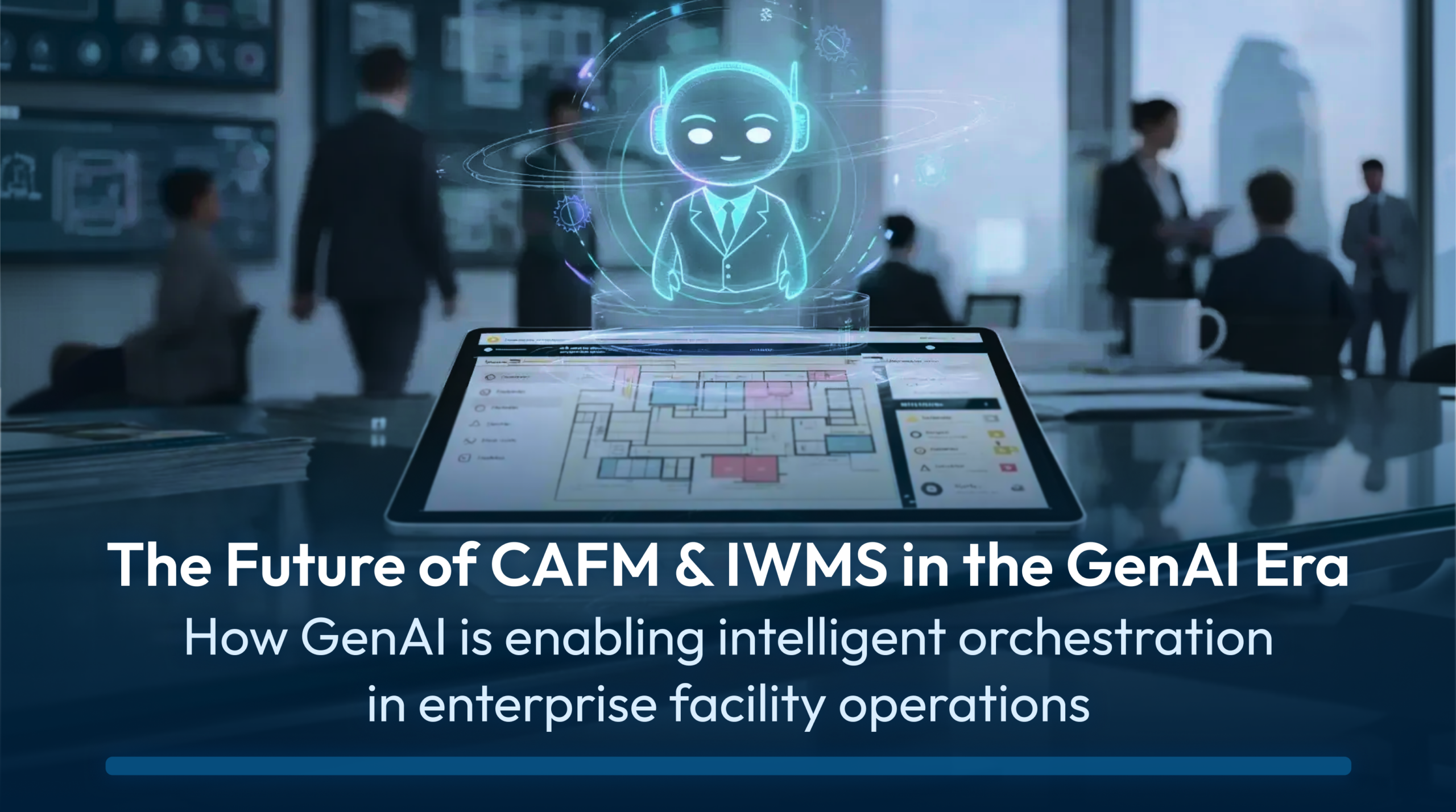
The next phase of CAFM and IWMS is not about adding more features or dashboards. It reflects a broader shift in AI in Facility Management, where systems begin to influence how decisions are made and how coordination happens in everyday operations.
The rapid emergence of Generative AI in Facility Management is accelerating this shift. It is enabling systems to understand intent, generate contextual responses, and reduce the cognitive effort required to operate complex environments.
Why Traditional IWMS and CAFM Systems of Record Are No Longer Enough
Traditional IWMS and CAFM platforms have played an important role in standardising facility operations. They reliably capture asset data, work orders, space allocations, energy metrics, and compliance records.
In practice, however, many platforms still behave primarily as systems of record.
They store information well.
They report after the fact.
They rely on people to interpret, navigate, and connect workflows under time pressure.
When something breaks, priorities shift, or leadership asks a question, the system does not participate. People do.
This growing gap between information and action defines the future of CAFM and IWMS and explains why existing operating models are increasingly under strain.
From Navigation to Intent: AI Capabilities in CAFM and IWMS
The first visible shift in AI in Facility Management, accelerated by Generative AI capabilities, is the move towards assisted operations.
Instead of forcing users to navigate screens and menus, systems begin to respond to intent. Natural language interaction powered by GenAI allows users to express operational intent rather than navigate system architecture. An employee expresses a need, a technician asks what requires attention, and a facility manager seeks context behind a spike or delay, all without navigating multiple interfaces.
What changes here is not authority or governance. Rules, approvals, and responsibilities remain exactly where organisations have defined them.
What disappears is friction.
Manual searching, repetitive navigation, and the effort required to move work forward are reduced. Teams spend less time chasing information and more time focusing on outcomes.
These AI capabilities in CAFM and IWMS do not remove control. They reduce effort.
Why Assisted Operations Alone Are Not Enough
While assisted operations improve individual productivity, facility management remains a coordination challenge.
A large portion of facility work never appears in dashboards or reports. Following up on delayed tasks. Prioritising competing requests. Escalating issues when SLAs are breached. Closing loops across vendors and internal teams.
This work is necessary, but it is also repetitive and time-consuming.
This is where agentic AI, building on foundational GenAI capabilities, begins to shape the future of CAFM and IWMS.
Rather than assisting one user at a time, agentic capabilities coordinate workflows across teams and systems. Follow-ups occur automatically when tasks stall. Escalations happen based on predefined rules. Work is prioritised based on impact and risk, not urgency alone.
The key difference is that coordination is no longer triggered solely by individual actions, but by system-level awareness of status, risk, and priority.
People do not disappear from the process. Their role evolves.
Teams move away from chasing work and towards governing outcomes.
The example below is one of several scenarios that illustrate how a single intent can trigger coordinated actions across space, services, and resources, without manual follow-ups or disconnected requests.
CAFM & IWMS as the Intelligence Layer in AI-Driven Facility Management
As systems begin to assist users and coordinate workflows, a broader implication emerges.
CAFM and IWMS platforms increasingly act as the intelligence layer of AI-driven facility management. In this model, GenAI enhances interaction, while the broader AI architecture governs orchestration, compliance logic, and decision integrity.
This becomes critical as physical execution evolves. Drones, robots, sensors, and automated inspection tools are already appearing in controlled environments. Without context, however, these remain isolated machines performing predefined tasks.
The intelligence does not sit in the device. It sits on the platform.
Asset history, compliance rules, risk thresholds, and priority logic guide when and how execution should occur. Inspections are triggered because conditions demand them, not simply because a schedule exists.
Automation shifts from being activity-driven to decision-driven.
The Future of CAFM and IWMS: From Managing Facilities to Orchestrating Them
Taken together, these shifts point to a fundamental change in how facility operations are designed and run.
The future of CAFM and IWMS lies in moving beyond recording work to supporting how decisions are made, how actions are coordinated, and how execution is guided at scale. As facilities become more distributed and expectations continue to rise, the cost of systems that only record work, rather than coordinate it, becomes harder to justify.
This evolution is less about replacing people and more about removing friction from everyday operations. As systems take on greater responsibility for coordination and context, facility teams gain the space to focus on outcomes, risk management, and long-term performance.
Platforms like eFACiLiTY® are being designed around this direction, with CAFM and IWMS treated not as static systems, but as intelligence layers that actively participate in operations and help organisations operate with greater clarity, control, and resilience.
Continue the conversation
Organisations evaluating the role of AI and GenAI in Facility Management can connect with us to explore how eFACiLiTY® supports intent-driven orchestration across enterprise facility environments.