
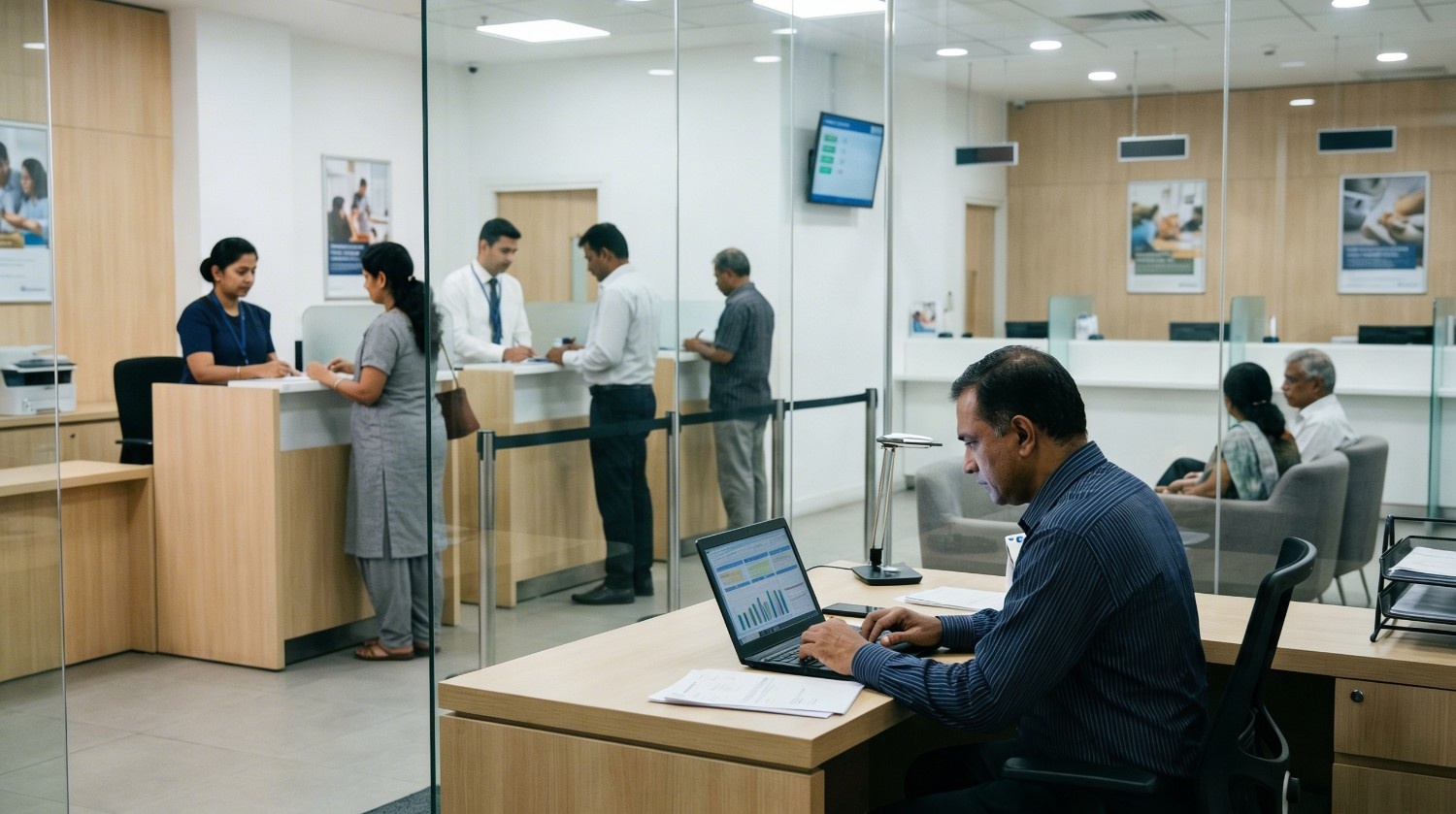
For CFOs managing bank branch networks, measuring and monetizing savings requires finance-grade data and scenario modeling. This guide explains how an IWMS combined with workplace performance analytics and an enterprise workplace transformation toolset turns branch real estate from a fixed-cost drag into measurable savings, with KPIs, ROI formulas and best practices tailored for banking.
Why IWMS Belongs on a CFO’s Agenda
The CFO perspective on real estate & occupancy costs
Customer migration to digital channels squeezes margins while branch portfolios remain a significant fixed-cost line—leases, utilities, maintenance and capex. An integrated workplace management system (IWMS) centralizes lease terms, square footage, utility consumption, service contracts and inventories into a single source of truth. That visibility converts an opaque cost pool into measurable line items that finance can forecast, control and audit.
Alignment with corporate finance goals
CFO priorities—forecast accuracy, capital efficiency and liquidity—are supported by IWMS through integrated lease calendars, maintenance plans and energy forecasts. Finance-grade scenario modeling shows P&L and balance-sheet impacts (including IFRS 16 / ASC 842 right-of-use effects) for consolidation, right-sizing, or capex deferral, strengthening negotiation leverage and lowering the cost of underutilized assets.
Quantifying ROI: How IWMS Drives Measurable Savings
Core cost levers and KPIs to track
- Occupancy cost per sq ft = Total occupancy expenses / Total occupied sq ft
- Utilization rate = visits or headcount per sq ft (by time bucket)
- Lease liability reduction (IFRS 16 / ASC 842 impacts)
- Energy cost per sq ft and energy reduction %
- MTTR (Mean time to repair) and maintenance spend as % of replacement value
Key ROI formulas (finance-friendly)
Occupancy cost per sq ft = Total occupancy expenses / Total occupied sq ft

Utilization improvement impact = (Baseline sq ft × Utilization % change) × Cost per sq ft

Payback period = Implementation cost / Annual net savings
Example: 750,000 sq ft at $40/sq ft = $30M annual occupancy expense. A 10% footprint reduction saves $3M annually. If IWMS implementation costs $1.5M, payback = $1.5M / $3M = 0.5 years (6 months), before additional energy or maintenance savings.
Use cases that convert to dollar savings
- Branch consolidation & right‑sizing: close or convert low-utilization branches to smaller formats to cut rent and operating costs.
- Space reallocation & shared services: regional hubs and flex pods reduce footprint while improving staff productivity.
- Lease negotiation & decommissioning: utilization and cost data improve renewal leverage and support break/exit decisions.
Map each use case to explicit financial outcomes: reduced rent, lower utilities, lower travel/overhead and deferred capex.
Deploying an Enterprise Workplace Transformation Toolset
Platform vs point solutions
Prioritize a platform that offers data integration, scenario modeling, finance reporting, security and vendor support over disconnected point tools. A unified platform reduces reconciliation, shortens decision cycles and provides auditability when feeding lease accounting and ERP systems.
Typical toolset components
- IWMS core: space, lease and move management
- Workplace performance analytics: utilization sensors, dashboards, predictive models
- CAFM: facilities operations, work orders and preventative maintenance
- Lease accounting feeds: automated ROU and liability updates for IFRS 16 / ASC 842
Together these components convert operational telemetry into financial forecasts and automated workflows that execute consolidation or remediation programs.
Best Practices: Implementing a Workplace Portfolio Optimization Platform
- Start with a pilot on high-cost, low-utilization branches to validate assumptions and measure realized savings.
- Establish CFO-led governance spanning real estate, operations, IT, risk and customer experience.
- Integrate HR, energy management, CAFM and lease accounting with master-data management, APIs and normalized metrics.
- For banks: require strict data residency, role-based access, encryption and enterprise SLAs (incident response, patching).
Workplace Performance Analytics: Turning Data Into Decisions
Real-time dashboards, occupancy heatmaps and predictive maintenance link branch-level P&L to utilization and physical metrics. Analytics should trigger automated workflows: space reassignments, scheduled preventive maintenance, or finance alerts when renewal windows open—reducing reactive spend and operational friction.
Example ROI Model & Short Case Outline
Sample 3-year scenario (conservative assumptions):
- 300 branches averaging 2,500 sq ft = 750,000 sq ft at $40/sq ft → $30M annual occupancy.
- Target 7% consolidation (21 branches) + 10% utilization-driven reallocation → ~ $5.1M annual rental-equivalent savings.
- Implementation + integration = $1.8M; platform costs = $300k/year → payback within 12 months under conservative assumptions.
Mini case (anonymized)
A regional bank used an IWMS plus workplace performance analytics to consolidate 9% of branches, renegotiate 12% of renewals and cut energy by 8%, producing an 18% reduction in occupancy-related expense and positive cashflow within nine months.
Risks, Pitfalls, and Mitigation Strategies
Common mistakes include poor data hygiene, automating without stakeholder buy-in, and setting unrealistic targets. Mitigate with a pilot-first rollout, CFO sponsorship, finance-tied KPIs, and ongoing measurement.
Conclusion
For CFOs, an IWMS combined with workplace performance analytics and an enterprise workplace transformation toolset converts real estate from a sunk cost into a managed asset. With disciplined data, phased execution and strong governance, IWMS delivers measurable cost reductions and improved capital efficiency.
Key Takeaways
- Single source of truth: IWMS gives CFOs centralized visibility into branch occupancy drivers and cost forecasting.
- Actionable insights: Workplace performance analytics plus an enterprise transformation toolset turn insight into consolidation, negotiation and operational savings.
- Start smart: Pilot high-impact branches, maintain CFO-led governance, and integrate finance, HR and facilities data to validate ROI and accelerate payback.
Discover how eFACiLiTY can help optimize your facility management with IWMS.




