
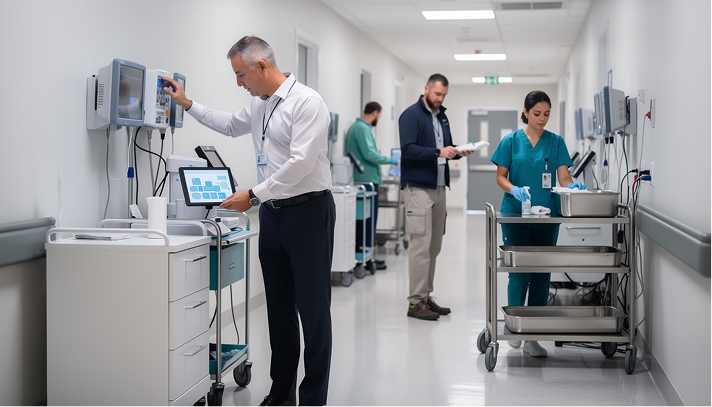
Hospitals operate where clinical care meets complex operations. Maintaining strict infection‑control protocols while keeping critical equipment available and compliant is essential for patient safety, regulatory compliance, and cost control. Many hospitals still rely on manual checklists, fragmented systems, and paper logs that create gaps in accountability and increase risk.
How Facility Management software strengthens infection‑control
Real‑time monitoring & workflow automation
Facility Management software automates cleaning and disinfection schedules based on room type, patient risk, and occupancy. Rather than relying on memory or spreadsheets, CAFM‑enabled platforms assign tasks, send alerts for missed or overdue work, and record completion with timestamps and digital signatures. Integration with IoT sensors — environmental monitors for temperature, humidity, and air quality — enables automatic triggers when parameters fall outside safe ranges and prompts immediate intervention.
Automation reduces variability in protocol adherence and shortens response times. In high‑acuity zones where turnover is frequent, automated workflows and mobile task lists ensure housekeeping and clinical engineering coordinate efficiently, minimizing delays that increase infection risk.
Compliance, reporting & traceability
Facility Management software standardizes protocols with checklist templates aligned to regulatory guidance (CDC, local health authorities) and internal policies. Each intervention is recorded, creating tamper‑proof audit trails that simplify regulatory reporting and incident investigations. Role‑based access controls ensure staff see only information relevant to their responsibilities while preserving accountability.
When an infection event requires root‑cause analysis, administrators generate consolidated timelines showing which rooms were cleaned, by whom, when sterilization batches were processed, and whether environmental conditions remained within spec. This level of traceability reduces investigation time and strengthens defensibility during audits.
Use cases: asset traceability and operations (RTLS, RFID, barcode)
RTLS and barcode/RFID for critical assets
Real‑time locating systems (RTLS) and barcode/RFID tags transform asset management for ventilators, infusion pumps, portable imaging, and other critical equipment. Staff can locate specific items in real time, reducing search time and freeing clinicians to focus on patient care. Visibility improves utilization rates, lowers emergency rentals, and reduces the risk of moving contaminated equipment between units without proper cleaning.
Example: in a busy ED, RTLS can route the nearest available transport ventilator with a verified sterilization record to the bedside, cutting minutes from response time and minimizing cross‑contamination risk.
Maintenance, sterilization & turnover workflows (CAFM‑enabled)
CAFM modules orchestrate preventive maintenance, log sterilization batch data, and enforce turnover checklists for patient rooms. Sterilization records — cycle parameters and operator sign‑offs — are linked to assets, enabling faster recalls and compliance reporting. Automated bed‑turnover workflows notify housekeeping, bed management, and nurse managers when rooms are ready, accelerating patient throughput and reducing hallway stays that increase infection exposure.
Linking maintenance history to asset lifecycle analytics informs replacement planning, ensuring aging equipment that may pose infection or reliability risks is prioritized.
Benefits and ROI for hospital administrators
Operational, clinical, and financial outcomes
- Reduces variability in infection‑control processes and can lower healthcare‑associated infection (HAI) rates.
- Improves asset visibility, reduces downtime and rental costs, and increases utilization.
- Avoids HAI‑related penalties and protects reimbursement tied to quality metrics.
Measurable KPIs to track success
Monitor these key performance indicators in CAFM dashboards:
- HAI incidence rates
- Cleaning‑compliance percentage
- Average time‑to‑locate an asset
- Asset utilization rates
- Maintenance SLA compliance
Overcoming adoption challenges and driving uptake
Common barriers and mitigation strategies
Integration complexity and data silos are common barriers. Mitigations include selecting platforms with open APIs, phased integrations, and prioritizing high‑value interfaces (EHR, inventory, environmental sensors). Address user resistance by involving clinicians and facilities staff in workflow design and delivering role‑specific training. Cost concerns can be reduced through pilot programs, ROI modeling, and phased rollouts demonstrating value before broader investment.
Best practices for successful adoption
- Secure executive sponsorship and create cross‑functional governance.
- Start with high‑impact pilots (e.g., RTLS for critical care, automated ED turnover).
- Use continuous measurement and feedback loops so workflows evolve with clinical needs.
Conclusion
Facility Management software — especially CAFM‑enabled platforms — delivers the automation, traceability, and analytics hospitals need to strengthen infection‑control and manage critical assets in real time. By aligning technology with clinical workflows and governance, administrators can reduce HAIs, improve asset utilization, and realize measurable operational and financial benefits.
Key takeaways
- Centralize infection‑control workflows and maintain tamper‑proof audit trails supporting regulatory compliance.
- Use RTLS, barcode, or RFID for real‑time asset traceability to cut search time and lower cross‑contamination risk.
- Leverage CAFM dashboards and KPIs to demonstrate ROI through reduced HAIs, lower downtime, and faster throughput.
- Address integration, training, and governance upfront through pilots and cross‑functional engagement.
Discover how a CAFM‑enabled Facility Management software can strengthen infection control and asset traceability at your hospital. Contact us today for a tailored demo and ROI assessment.




