
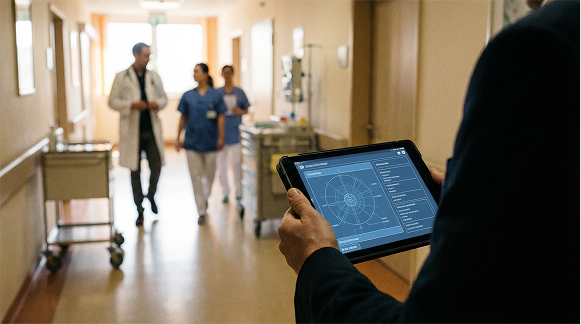
Why facility management software matters for hospitals
Hospitals face strict regulatory requirements from organizations like the Joint Commission, state health authorities, and device manufacturers, plus guidance from ASHRAE and HTM for systems such as HVAC and medical gas. Relying on manual checklists and siloed records increases audit risk and makes evidence retrieval slow. Facility management software centralizes the asset master, creates timestamped audit trails, and enforces workflows to ensure recurring checks are completed with photographic or signature evidence.
The operational and regulatory stakes
- Audit readiness: Timestamped, auditable records shorten response time during inspections.
- Patient safety: Preventive and condition-based maintenance keep imaging, labs, and critical systems online.
- Cost control: Converting emergency repairs into planned work reduces overtime and on-call premiums.
Key hospital use cases
Compliance checklist automation
Digitize recurring inspections with mobile forms that capture timestamps, photos, and electronic signatures. Automated reminders and escalation rules ensure checks are completed and unresolved items are routed to the right technician or vendor, producing an immutable audit trail.
Preventive and predictive maintenance
Link PM schedules to critical assets—imaging equipment, HVAC, emergency generators—and feed IoT sensor data into the CAFM/CMMS to trigger condition-based work orders. Shifting work from reactive to planned reduces overtime, lowers MTTR, and improves PM compliance.
Asset tracking and vendor management
Use RTLS, QR/barcode tags, and lifecycle records to locate equipment, manage consumables, and coordinate vendor SLAs in one platform. Centralized contract and SLA monitoring minimizes after-hours calls and administrative friction that raises labor costs.
Benefits, challenges, and adoption best practices
Measurable outcomes
- Overtime reductions (typical pilot results: 10–30%)
- Higher scheduled PM percentage and lower emergency work-order share
- Faster retrieval of compliance evidence and improved audit pass rates
- Increased asset uptime and fewer canceled procedures
Common barriers and mitigations
- Poor asset master data: Conduct phased cleanup and prioritize high-risk assets first.
- Frontline resistance: Create super-user groups and run hands-on training; keep mobile-first and offline capability.
- Integration complexity: Choose solutions with open APIs and pre-built healthcare connectors for EHR, BMS, and IoT.
- Budget and governance: Run targeted pilots, define cross-functional roles, and standardize naming conventions and SOPs.
Feature checklist when selecting a CAFM/CMMS for hospitals
- Robust checklist automation with photo/evidence capture and e-signatures
- Advanced scheduling and predictive maintenance capabilities
- Asset lifecycle management, inventory control, and RTLS support
- Vendor and SLA management with contract tracking
- Dashboards for compliance and financial KPIs (PM compliance, MTTR, overtime)
- Strong security, role-based access, and complete audit logging
Adoption roadmap — pilot to ROI
- Select a high-impact pilot (imaging, HVAC, or power systems).
- Clean and prioritize asset data for the pilot scope.
- Engage clinical and facilities stakeholders early; appoint super-users.
- Integrate IoT sensors and vendor SLAs where practical.
- Measure PM compliance, emergency work percentages, MTTR, and overtime before/after.
Conclusion
Facility management software transforms hospital maintenance from reactive and paperwork-heavy to automated, auditable, and predictable. Automating compliance checklists, enabling predictive maintenance, and centralizing vendor and asset data reduces overtime, improves audit readiness, and increases equipment uptime — directly supporting patient safety and operational resilience.
Discover how our CAFM solution can automate your hospital’s compliance workflows and cut overtime costs. Contact us today for a demo and a free initial asset risk assessment.




