
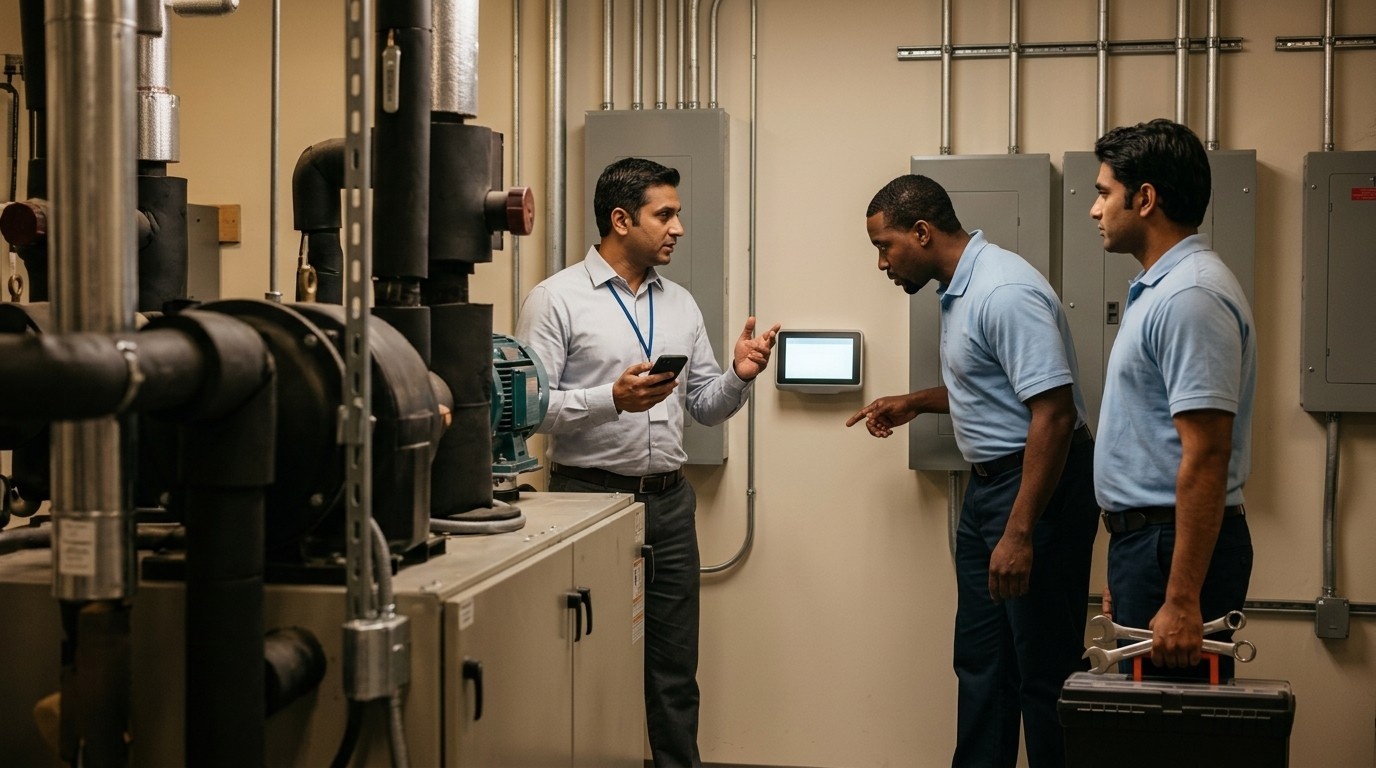
This Facility Management software checklist focuses on cutting repair spend by prioritizing preventive maintenance (PM) planning, digitizing operations with CAFM/CMMS, and streamlining service coordination and governance.
Core CAFM/CMMS capabilities to require
To reduce repairs and shift from reactive fixes to predictable upkeep, require a CAFM or CMMS with features that centralize data, enforce workflows, and enable mobile field work.
- Centralized asset inventory — location, lifecycle, warranty, manufacturer data and criticality ranking for focused asset management.
- Work order creation & tracking — classification, prioritization, approvals and closure records to maintain accountability.
- Preventive maintenance scheduling — automated PMs based on manufacturer guidance, runtime, and condition triggers.
- Mobile technician access — offline capability for field teams to receive tasks, record labor & parts, and close orders.
- Integrations — BMS, IoT sensors, ERP and vendor portals so alarms, procurement and financials flow automatically.
- Role-based access & audit trails — approvals, compliance and secure collaboration with third-party vendors.
How preventive maintenance planning reduces repairs
Build a practical PM program
A targeted preventive maintenance program reduces emergency repairs and extends asset life. Focus PM resources using real data and condition-based triggers.
- Criticality ranking: identify assets whose failure impacts operations, safety, or occupant experience most.
- Frequency by data: set PM intervals using manufacturer guidance, usage, and historical failure trends — avoid arbitrary calendars.
- Condition-based monitoring: integrate vibration, temperature, pressure and runtime sensors to trigger inspections when metrics deviate.
- Automated PMs: link tasks in the CAFM to spare parts, SOPs and inspection checklists so technicians arrive prepared.
- Follow-up governance: track completion, require root-cause analysis for missed PMs or repeat failures, and implement corrective maintenance.
Digitize operations: integrations and data strategy
What to digitize first and why
Digitization makes maintenance measurable and predictive. Start with the highest-impact data and connections.
- Asset records & work-order history: capture historical faults and parts consumption to identify recurring issues and predict failures.
- Connect CAFM to BMS & IoT: feed real-time alarms into the CMMS to auto-create work orders or triage workflows.
- Standardized taxonomy: unify naming conventions and data fields across sites and vendors for reliable reporting and benchmarking.
- Dashboards & alerts: surface PM compliance gaps, trending failures and spare-part shortages so leaders can act proactively.
Streamline vendor coordination and service delivery
Contractors are essential but introduce variability. Enforce consistent service delivery and control repeat callouts with digital vendor management.
- Central request intake: one portal for service requests and an approved vendor roster to maintain pricing and quality consistency.
- SLA-driven dispatch: automated vendor assignment, response-time rules and escalation to meet expectations.
- Digital procurement controls: PO generation and invoice matching reduce reconciliation delays and scope creep.
- Mobile contractor updates: require real-time status, safety notes and parts usage so coordinators can monitor progress.
Operations workflow management: design and governance
Efficient, software-enforced workflows remove bottlenecks that prolong downtime and increase repeat repairs.
- Map end-to-end workflows: request → triage → schedule → execute → close, with clearly documented decision points.
- Conditional routing & escalations: route high-priority incidents automatically and avoid queueing delays.
- Root-cause enforcement: require RCA for repeat failures and deploy corrective maintenance to fix systemic issues.
- Measure KPIs: track MTTR, MTBF and PM compliance to demonstrate improvements and guide resource allocation.
Implementation checklist & rollout tips
Adopt CAFM/CMMS in phases to limit disruption and build confidence with technicians and vendors.
- Pilot: start with one building or asset class to validate workflows and configurations.
- Data cleanse in stages: import asset and vendor records progressively to avoid garbage-in issues.
- Train field teams: technicians, coordinators and contractors must be fluent on mobile workflows and SOPs.
- Set KPIs & review cadence: define short- and long-term targets and hold regular performance reviews.
- Feedback & audit loops: perform periodic audits, capture user feedback, and keep the CAFM updated with new integrations.
Conclusion — turn reactive maintenance into predictable performance
A focused Facility Management software checklist — centered on preventive maintenance planning, CAFM/CMMS-driven digitization, coordinated service delivery, and strict workflow governance — shifts operations from firefighting to measurable, cost-controlled maintenance.
Key takeaways
- Require a prioritized feature set: centralized asset data, PM schedules, mobile work orders and integrations.
- Use preventive and condition-based maintenance to target the right work and extend asset life.
- Digitize operations and enforce vendor SLAs to reduce response times and repeat callouts.
- Adopt phased rollouts, clear governance and KPI tracking to ensure adoption and continuous improvement.
Discover how eFACiLiTY can help you implement this checklist and reduce repair costs across corporate offices and headquarters.




