
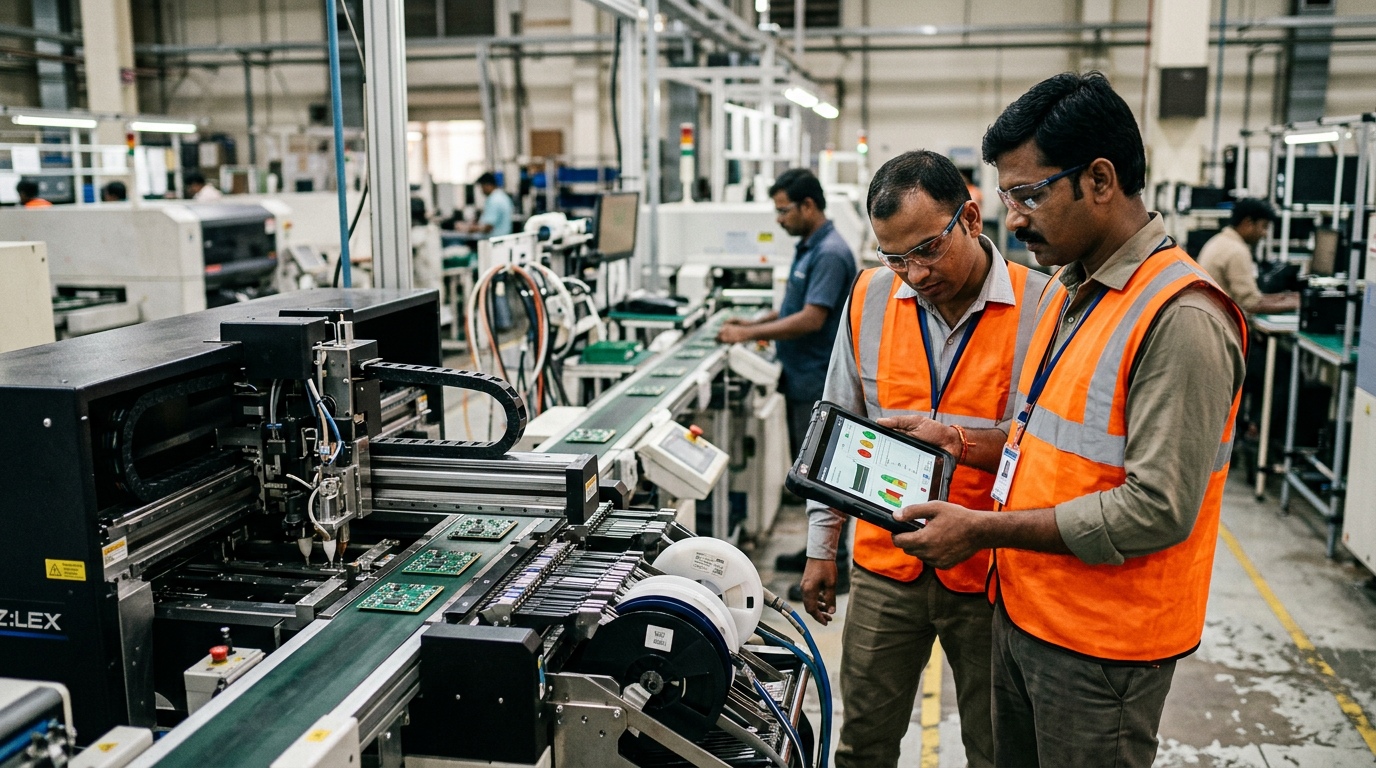
Why EAM software matters for SMT line uptime
SMT (surface-mount technology) lines are high-value, high-throughput assets. Short unplanned stops cascade across placement machines, feeders, ovens, AOI, and conveyors — increasing scrap, labor costs, and late shipments. Deploying robust EAM software centralizes asset data and maintenance workflows so teams can reduce emergency work, increase availability, and extend equipment life.
Typical ROI levers: fewer emergency part purchases, less start-stop scrap, and lower mean time to repair (MTTR) through better diagnostics and parts availability. A simple justification: map average monthly downtime minutes to lost throughput and labor cost, then estimate gains from a 10–20% reduction in unplanned stops.
Core checklist: production equipment maintenance software features to prioritize
1. Preventive maintenance for assembly lines: scheduling & repeatable work
Ensure the EAM supports flexible PM triggers and repeatable procedures:
- Configurable PMs by run-hours, board counts, cycle counts, or calendar intervals.
- Standardized PM checklists with SOP attachments, torque specs, and photos/videos.
- Automatic work-order generation, approvals, and escalation rules to prevent missed PMs.
2. Downtime tracking for critical machines: real-time capture & analytics
Accurate downtime attribution is essential to reducing SMT line downtime:
- Automatic logging via PLC/IIoT feeds plus quick manual entries on handheld devices.
- Standardized reason codes that separate planned vs unplanned stops and map to OEE components.
- Dashboards that show fault-code trends, short-stop patterns, and alerts for repeated faults or consecutive stoppages.
3. Asset lifecycle management in plants: single source of truth
Reduce confusion and repair delays with a centralized asset registry that contains:
- BOMs, serial numbers, CAD drawings, firmware versions, and maintenance history.
- Lifecycle states (commissioned, in-service, decommissioned), warranty data, and vendor support details for faster replace-vs-repair decisions.
4. Integrations (MES, PLC, IoT, ERP)
Require bi-directional integrations so maintenance work is context-rich and parts flows are automated:
- MES integration passes production context (job, lot, yield) to work orders.
- PLC/IoT feeds enable automated fault detection and precise downtime attribution.
- ERP and spare-parts linkage ensures parts are reserved or auto-ordered when work orders are created, reducing MTTR.
Advanced capabilities that reduce repeat downtime
Predictive maintenance & condition monitoring
Move beyond calendar PMs by piloting condition monitoring on critical SMT machines (pick-and-place, reflow ovens, AOI):
- Sensors: vibration, thermal imaging, acoustic, and electrical signatures.
- Alerting: simple rule-based thresholds plus the option to deploy ML anomaly detection after validating false-positive rates.
- Pilots: prove business impact before scaling to preserve trust and minimize disruption.
Root cause analysis and reliability engineering tools
Built-in RCA workflows accelerate corrective actions and prevent repeats:
- Integrate 5 Whys, fishbone diagrams, and action-tracking directly with work orders.
- Track MTTR, MTBF, and failure frequency by asset class to prioritize reliability projects.
Mobile, role-based workflows and field enablement
Enable technicians at the point of work with:
- Mobile apps with barcode/RFID scanning, photo/video capture, and offline capability.
- Step-by-step troubleshooting, embedded SOP videos, and push notifications for priority work.
Implementation and operational best practices
Data hygiene, governance, and onboarding
Start with clean asset data and a phased rollout:
- Standardize naming, hierarchy, and BOMs before go-live.
- Define KPIs and reporting cadence; pilot on one SMT line, measure impact, then expand.
Change management and training for plant teams
Deliver role-specific training and clear governance:
- Train technicians, planners, supervisors, and reliability engineers on workflows and taxonomy.
- Limit who can create work orders and enforce reason-code discipline to avoid backlog noise.
- Create a continuous improvement loop so floor feedback refines PMs and fault-code taxonomies.
Measuring success: dashboards and KPIs
Track a focused KPI set and review regularly:
- Downtime minutes per line, PM compliance %, MTTR, MTBF, emergency work-order ratio.
- Link downtime events to root causes on dashboards and review month-over-month and quarterly with stakeholders.
Conclusion & key takeaways
Reducing SMT line downtime is both a technology and process challenge. Prioritize EAM capabilities that deliver measurable uptime improvements:
- Automated PMs and repeatable procedures to reduce avoidable failures.
- Real-time downtime capture with standardized reason codes and OEE analytics to drive corrective actions.
- Integrations with MES, PLC/IoT, and ERP to automate fault detection and parts availability, shortening MTTR.
- Measure success with downtime minutes, PM compliance, MTTR, and MTBF; pilot and scale based on proven impact.




