
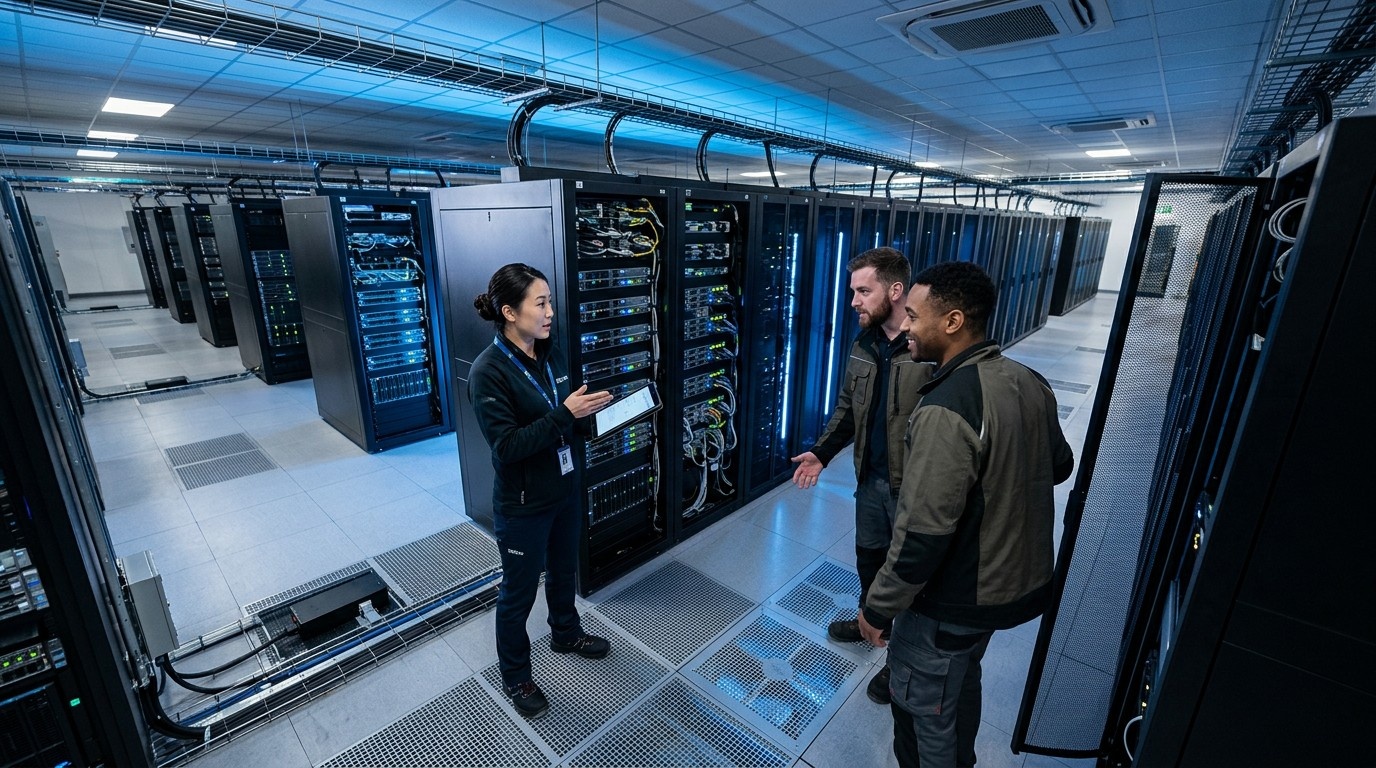
IWMS to cut data center PUE through rack consolidation, airflow optimization, and smarter workload placement—save energy.”
How space utilization software reduces data center PUE
Space utilization software correlates occupancy, rack metadata, environmental telemetry, and power feeds to create a unified operational view. That visibility exposes underused racks, hotspots, and inefficient cooling allocation—enabling targeted actions that lower PUE.
What the software measures and visualizes
The platform merges multiple data sources—occupancy and space metadata, PDUs and breakers, environmental sensors, DCIM asset feeds, and BMS telemetry—into dashboards that answer operational questions like:
- Which racks draw cooling but deliver no productive compute?
- Where do hotspots form during peak hours?
- Which aisles suffer airflow starvation or leakage?
Typical visualizations include real-time floor heat maps, time-series power-per-rack charts, and airflow imbalance indexes. These views enable rapid identification of consolidation targets, containment needs, and workload-placement opportunities.
Typical PUE reduction pathways
- Consolidation and decommissioning: Migrate workloads from low-utilization racks and decommission idle hardware—pilots often show 5–15% facility energy reductions from modest consolidation.
- Hot/cold aisle and containment optimization: Use heat maps and airflow models to install targeted containment, seal leakage, and reposition CRACs so setpoints can be raised safely.
- Smarter workload placement: Align non-critical or batch jobs to cooler zones or off-peak windows to flatten thermal peaks and reduce peak cooling runtime.
Key metrics and KPIs to track with workspace usage analytics
To quantify progress and maintain gains, track both facility-level and operational KPIs.
Essential KPIs for PUE improvement
- PUE and DCiE: Baseline, rolling averages, and peak comparisons to quantify impact.
- Rack-level power density: Watts per U and watts per rack to identify over- and under-utilized power capacity.
- Cooling capacity utilization: Fraction of CRAC/chiller capacity actively used versus installed capacity.
- Airflow imbalance index: Deviation between supply and return air temperatures across aisles.
Operational KPIs for space and capacity
- Rack/server utilization: Percent of compute/storage capacity actually used.
- U-space occupancy: Percentage of occupied and productive rack U-space.
- Power per U and unused capacity trends: Rolling trends to identify consolidation or expansion needs.
Data sources & integration: connect DCIM, BMS and IWMS
Effective optimization depends on high-quality, integrated data. Combine environmental sensors, PDUs, DCIM asset feeds, and BMS telemetry with an IWMS/Space Management System to add spatial and tenancy context (rack purpose, SLA tier, lease boundaries).
Sensors and system feeds
- Environmental sensors: temperature, humidity, differential pressure for aisle-level heat mapping.
- PDUs and smart breakers: per-rack power draw and power quality.
- DCIM: asset inventory, connectivity, and capacity models.
- BMS: chiller/CRAC performance and HVAC operating states.
- IWMS/Space Management System: rack role, tenant/department, and SLA metadata.
Data quality and governance
Use calibrated sensors, synchronized timestamps, anomaly detection, and role-based governance that defines who can approve automated changes (e.g., setpoint changes or workload migrations). These guardrails prevent oscillations and unsafe conditions.
Use cases & proven strategies
Rack consolidation and capacity planning
Identify low-use racks and model the cooling and power savings of removal. A pilot consolidation (for example, consolidating 10% of racks) can be translated into kW reductions and fed into an ROI model.
Cooling optimization and airflow management
Use heat maps to guide containment installation, CRAC repositioning, and variable-speed fan tuning. Combining containment with setpoint automation yields immediate reductions in fan and chiller energy.
Dynamic workload placement and scheduling
Integrate with orchestration and job-scheduling systems to shift non-urgent jobs to cooler zones or off-peak windows. Flattening thermal peaks reduces peak cooling runtime and supports higher average setpoints while maintaining SLAs.
Implementation roadmap & best practices
Adopt a phased approach to reduce risk and demonstrate measurable value:
- Phase 1 — Assess and instrument: Baseline PUE, inventory assets, deploy environmental sensors, connect PDUs to DCIM, and integrate IWMS for spatial context.
- Phase 2 — Analyze and pilot: Model consolidation and cooling scenarios; run room- or aisle-level pilots to validate assumptions and measure outcomes.
- Phase 3 — Scale and automate: Automate validated controls (setpoints, fan curves, consolidation workflows) and embed SLAs and governance so Facilities, IT, and CRE respond consistently.
Calculating ROI and the business case
Convert kW reductions to annual kWh savings and local energy costs to quantify dollar returns. Conservative scenarios (3–7% PUE improvement) typically show rapid payback for sensor and software investments. Include non-energy benefits—longer equipment life, fewer incidents, deferred expansions, and improved CRE reporting and chargeback—to strengthen the case.
Conclusion & key takeaways
Integrating space utilization software with DCIM, BMS, and an IWMS/Space Management System gives data center teams the visibility and control needed to reduce PUE. By measuring room- and rack-level usage, correlating occupancy with IT load, and automating validated controls, operators can cut cooling waste, consolidate capacity, and make smarter workload-placement decisions—delivering measurable energy, cost, and operational benefits.
Key takeaways
- Space utilization software exposes underused capacity and thermal inefficiencies that directly enable PUE reductions.
- Integrating workspace usage analytics with DCIM, BMS, and an IWMS creates a single source of truth for targeted cooling and consolidation.
- A phased assess→pilot→scale approach with cross-functional governance produces measurable energy savings and operational resilience.




